DDoS Protection for Servers: How to Stay Online When Traffic Turns Hostile
Good DDoS protection rarely gets attention until the day a website stops responding for reasons that have nothing to do with real customers. At Arise Server, we believe that preparing for an attack is cheaper and calmer than reacting to one, because the first hour of an outage is usually the most expensive.
Well, a DDoS attack does not need to break into your server. It only needs to keep real visitors from reaching it. Apart from that, you also need to know that attacks vary widely, from huge floods that fill a network connection to small, targeted request streams that quietly exhaust an application. Many businesses only learn how exposed they are when the first attack arrives, which is the costliest way to find out.
With this blog, Arise Server aims to guide you through how DDoS attacks work, which types exist, what mitigation involves, and how to estimate the cost of doing nothing.
What is a DDoS attack?
Before we look at defences, let’s begin with what exactly a DDoS attack is. Primarily, a distributed denial-of-service attack uses many compromised devices to send traffic or requests to one target at the same time, so legitimate users cannot get through.
Be it an online store, a game server, a banking portal, or a company website, any service that depends on being reachable can become a target.
Here’s what DDoS protection typically aims to handle:
- Volumetric floods that fill network capacity
- Protocol attacks that exhaust connection tables
- Application-layer attacks that overload web requests
- Repeated short bursts that test defences
Moreover, attackers often combine methods, which is why one tool rarely covers everything.
Dedicated Server Plans
Arise Dedicated Servers deliver powerful performance, reliable infrastructure, and flexible resources for businesses, high-traffic websites, applications, and demanding workloads.
How do the main attack types differ?
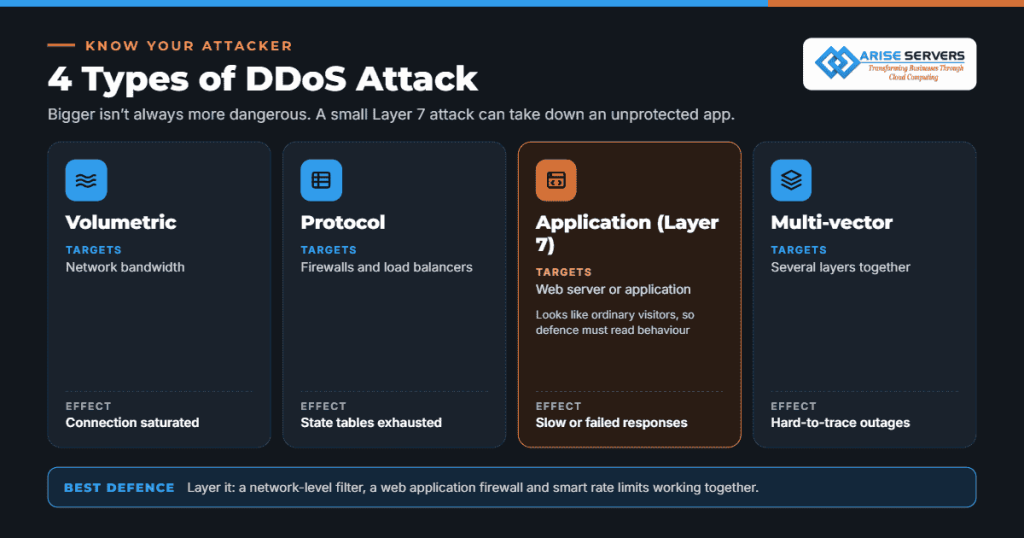
A common assumption that we have noticed at Arise Server is that bigger attacks are always the
dangerous ones. In practice, a small Layer 7 attack can take down an unprotected application with very little traffic.
Let’s understand the same through these points:
| ATTACK TYPE | TARGET | TYPICAL EFFECT |
| Volumetric | Network bandwidth | Connection saturated |
| Protocol | Firewalls and load balancers | State tables exhausted |
| Application (Layer 7) | Web server or application | Slow or failed responses |
| Multi-vector | Several layers together | Hard-to-trace outages |
Having said that, the right defence depends on where your weak point sits, so a network-level filter, a web application firewall, and smart rate limits often work best together.
Layer 7 attacks deserve special mention. They look like ordinary visitors, so the defence needs to understand behaviour, such as unusual request patterns, repeated login attempts, or heavy searches from a small set of sources.
Read Also: Ecommerce Hosting for Peak Sales: How to Prepare Your Server Before the Rush
Why does DDoS protection matter for your business?
When a checkout fails during a promotion or a portal freezes in working hours, customers move on, and some do not return. So, when you plan DDoS protection in advance, you protect revenue, reputation, and search visibility.
Moreover, effective protection is more than a single setting. Understand it through these signals:
- Detection speed
- Mitigation capacity
- Always-on or on-demand coverage
- Traffic filtering accuracy
- Monitoring and support response
Preparation also includes a response plan. Decide who monitors alerts, who contacts the hosting
provider, and how customers will be informed, because clear roles save minutes when minutes matter.
Arise Server provides infrastructure options with network-level protection, so you can align your
defence with the risk your business actually faces.
VPS Server Plans
An ideal VPS solution for modern projects combines strong security, high-speed performance, and flexible, scalable configurations to match your evolving requirements.
How do you estimate the cost of an attack?
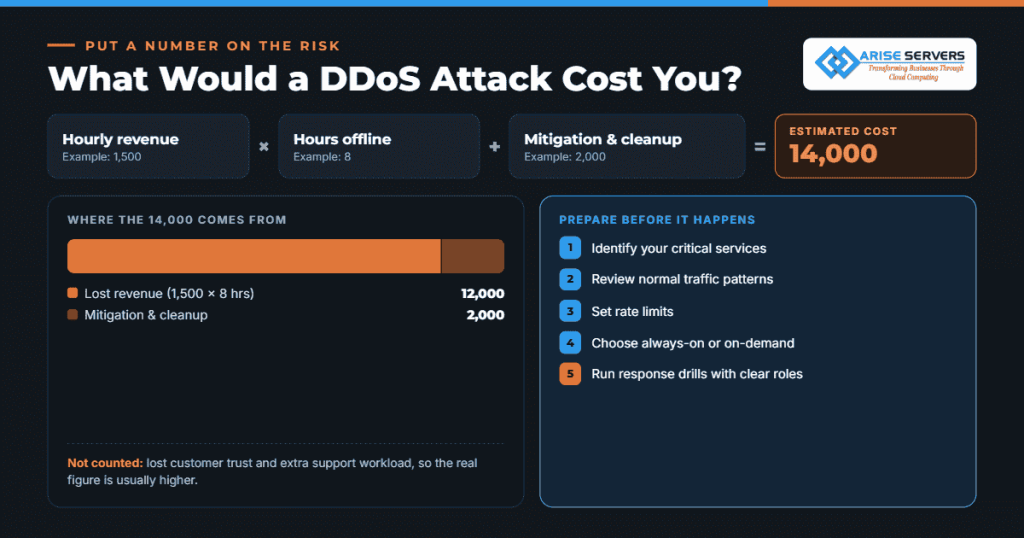
Now that we know why protection matters, let us move on to putting a number on the risk, because it makes planning simpler.
FORMULA:
- Estimated attack cost = Hourly revenue X Hours offline + Mitigation and cleanup cost
For example, if a business earns 1,500 an hour, an attack keeps it offline for 8 hours, and cleanup costs 2,000, the estimate is 1,500 X 8 + 2,000, which equals 14,000. Even a modest estimate like this makes the case for preventive protection easier to present to management.
Now, this leaves out lost trust and support workload, so the real figure is usually higher. At Arise
Server, we can use this process to identify critical services, review traffic patterns, set rate limits,
choose between always-on and on-demand mitigation, and run response drills so your team knows exactly what to do.

Conclusion
In conclusion, DDoS protection is part of keeping a service reliable, and it works best when it is
planned, tested, and matched to the threats your business realistically faces. A tested plan also
shortens the time between the first alert and normal service.
Hence, at Arise Server, our goal is not to give you the most expensive shield available but to help
you select infrastructure that meets your requirements today and leaves room for tomorrow’s growth.
FAQ’s
Visit Our Other Server Locations
Explore our global dedicated server locations with high performance, strong security, and scalable configurations tailored for your business needs.