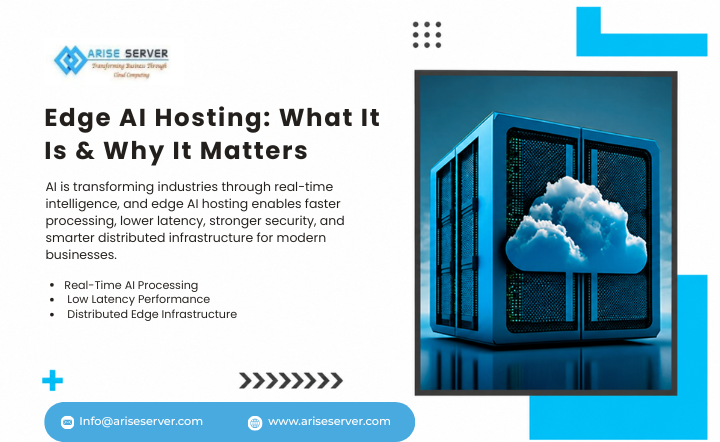
Edge AI Hosting: What It Is & Why It Matters
Artificial intelligence has moved far beyond the walls of research laboratories and technology giants. It now powers real-time fraud detection in banking applications, monitors equipment health on factory floors, enables autonomous navigation in vehicles, and drives intelligent decision-making in healthcare systems. But as AI workloads grow more demanding and more time-sensitive, a fundamental question has emerged: where should AI actually run?
For years, the default answer was the cloud. Send data to a centralized server, process it, and return the result. That model worked reasonably well when response times of a few seconds were acceptable. Today, many applications simply cannot afford that delay. This is where edge AI hosting enters the picture, and why it is quickly becoming one of the most important infrastructure decisions for modern businesses.
What Is Edge AI Hosting?
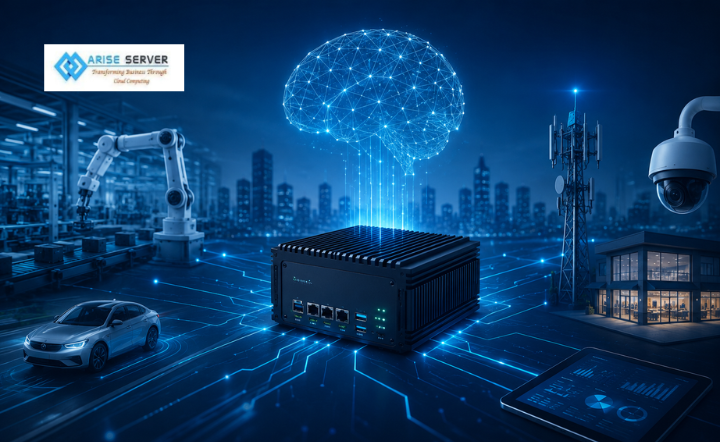
Edge AI hosting refers to the deployment of artificial intelligence models and workloads on servers or computing hardware positioned physically close to the source of data, rather than routing everything through a distant centralised cloud. The “edge” in this context means the boundary between the physical world and the digital network: a factory floor, a hospital ward, a retail store, a vehicle, or a cell tower.
Instead of sending raw data across long distances to a cloud data centre for processing, edge AI hosting allows inference and analysis to happen locally or regionally. The result reaches the end user or the system almost instantly, without the round-trip delay that cloud dependency introduces.
This is not simply a technical preference. For applications where milliseconds matter, autonomous systems, real-time video analytics, industrial automation, and medical diagnostics, the architecture of where AI runs is as important as the AI model itself.
Dedicated Server Plans
The ideal solution for large-scale projects delivers strong security, top-level performance, and customizable configurations.
The Problem with Cloud-Only AI
While cloud computing remains a vital part of modern infrastructure, relying solely on centralised cloud environments for AI processing introduces serious challenges. Latency is the most pressing issue, data travelling between devices and distant cloud servers creates delays that are merely inconvenient for e-commerce platforms but genuinely dangerous for autonomous systems.
Bandwidth costs present another obstacle, as continuously streaming large volumes of raw data including video feeds and sensor readings is expensive and inefficient. Processing data locally along with transmitting only relevant output is far more practical. Additionally, data privacy and sovereignty regulations in many industries restrict where data can be stored as well as processed, creating compliance risks that edge computing AI resolves by keeping processing close to the source.
erver Requirements
How Edge Computing AI Works in Practice
Edge computing AI is used to spread the work of executing AI models to a network of geographically distributed nodes. These nodes, varying in size with some purpose-built AI edge server hardware up to ruggedised computing units in remote locations, can execute machine learning inference within the node without necessarily being connected to a central system at all times.
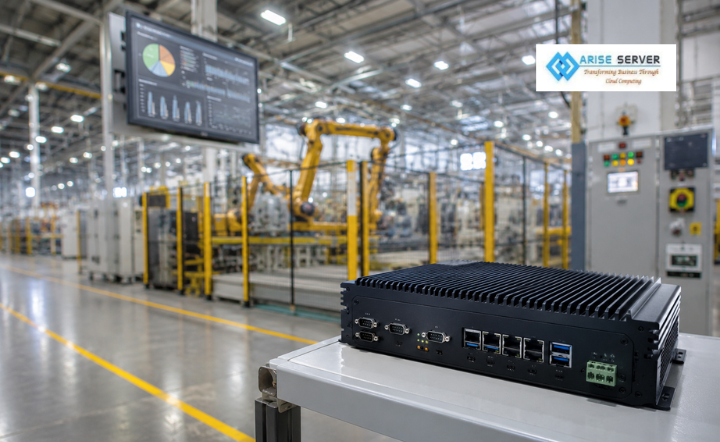
Take into account a smart manufacturing plant. The production line has cameras and sensors that produce constant sources of data. Instead of sending all frames to a cloud server to check their quality, an AI edge server on site analyzes the video in real time, marks defects immediately, and sets off automated actions without cloud round trip. The speed, efficiency and reliability of this solution is much better than what a cloud reliant system would provide within the same environment.
The same logic applies to retail analytics, where in-store cameras analyse customer behaviour without transmitting personal footage off-premises. It applies to healthcare, where diagnostic tools process patient data locally to maintain privacy. It applies to telecommunications, where network equipment uses AI to manage traffic at the source.
Why Low Latency AI Hosting Is a Competitive Advantage
Speed is not just a technical metric, it is a business outcome. A low latency AI hosting enables organisations to act on intelligence faster than competitors who are still waiting for cloud responses. In financial services, faster fraud detection means fewer losses. In logistics, real-time route optimisation means lower costs and better customer satisfaction. In healthcare, rapid diagnostic analysis means better patient outcomes.
Beyond individual transactions, low latency AI hosting supports a fundamentally different architecture for intelligent systems, one where decisions happen at the moment of need, not after a network round-trip. This changes what is possible, not just how quickly existing processes run.
As consumer expectations around real-time experiences continue to rise, businesses that can deliver instant, intelligent responses will hold a meaningful advantage over those constrained by the limitations of purely centralized processing.
The Role of Distributed AI Infrastructure
Scaling edge AI is not simply a matter of placing a single powerful server in one location. It requires a thoughtful distributed AI infrastructure, a coordinated network of edge nodes, and regional data centres, along with centralised cloud environments that each handle the workloads best suited to them.
Lightweight inference is performed at the edge in this hybrid model, where speed is most important. Training of more complex models and aggregation of large amounts of data occurs in regional or central environments where the depth of computation is present. Those layers are connected by a distributed AI infrastructure that enables businesses to implement AI at scale without compromising the performance or flexibility.
The effective operation of this infrastructure needs providers like Arise Server that are aware of the hardware requirements of edge environments as well as the complexity of networking that accompanies the geographic distribution. Selecting the appropriate edge AI hosting provider like Arise Server requires more than assessing the server characteristics of a given provider, but also the capacity to deploy a coherent, integrated architecture to multiple sites.
VPS Server Plans
An ideal VPS solution for modern projects combines strong security, high-speed performance, and flexible, scalable configurations to match your evolving requirements.
Conclusion
The shift toward edge AI hosting reflects a broader maturation in how businesses think about artificial intelligence. AI is no longer just a tool for analysis and insight, it is becoming the backbone of real-time operational decision-making. That shift demands infrastructure designed for speed, resilience, and intelligent distribution.
Organisations that invest in the right distributed AI infrastructure today are not simply solving a technical problem. They are building the foundation for a generation of applications that were previously impossible, and positioning themselves to lead in an economy where intelligent, instant responses are the standard, not the exception.
Visit Our Other Server Locations
Explore our global dedicated server locations with high performance, strong security, and scalable configurations tailored for your business needs.