
SPF, DKIM, and DMARC Explained: Why Your Emails Might Be Landing in Spam
If your legitimate emails also keep landing in spam, SPF DKIM DMARC might be part of the answer. The simple reason behind it is the fact that email authentication is becoming harder to ignore. Which means you could be having a legitimate domain, a genuine business, and an important message to send, yet your business can no longer send email from a single mail server.
Whether it’s invoices, password resets, order confirmations, sales proposals, marketing campaigns, support tickets, security alerts, or account notifications, all of these are being treated as suspicious and pushed into spam, which is scary. As a business, you should know that at the receiving end, mailbox providers are becoming increasingly strict about sender identity and email authentication. Especially when Google’s current sender requirements state that all senders should authenticate their domains with SPF or DKIM. Alongside this, bulk senders are also expected to implement SPF, DKIM DMARC to be aligned with the visible “From” domain for direct mail to personal Gmail accounts. Having said that, SPF, DKIM, and DMARC do not necessarily mean that every email will land in the inbox. Rather, authentication stands as a part of a larger deliverability equation that includes reputation, spam complaints, sending behaviour, infrastructure, and recipient engagement.
This blog aims to understand how SPF, DKIM, DMARC technologies work together; why authenticated emails can still end up in spam; and what, as businesses, you should consider while building an email authentication strategy that can not only keep pace with modern sending requirements but also prevent your important emails from ending up in spam.
What are SPF, DKIM, and DMARC?
A major part of understanding why your emails might be landing in spam is understanding what SPF DKIM DMARC are and how they work together. Well, to begin with, these are complementary email authentication methods that helps receiving mail servers determine if an email claiming to come from a domain is legitimate or not.
Here’s a better outlook on what SPF DKIM DMARC are:
| TECHNOLOGY | FULL FORM | PRIMARY PURPOSE |
| SPF | Sender policy framework | Domain-based message authentication, reporting & conformance |
| DKIM | DomainKeys identified mail | Cryptographically signs messages |
| DMARC | Domain-based message authentication, reporting & conformance | Adds alignment, policy, and reporting |
While together these create complementary layers of email authentication, these are not interchangeable.
VPS Server Plans
An ideal VPS solution for modern projects combines strong security, high-speed performance, and flexible, scalable configurations to match your evolving requirements.
How do SPF, DKIM, and DMARC work together?
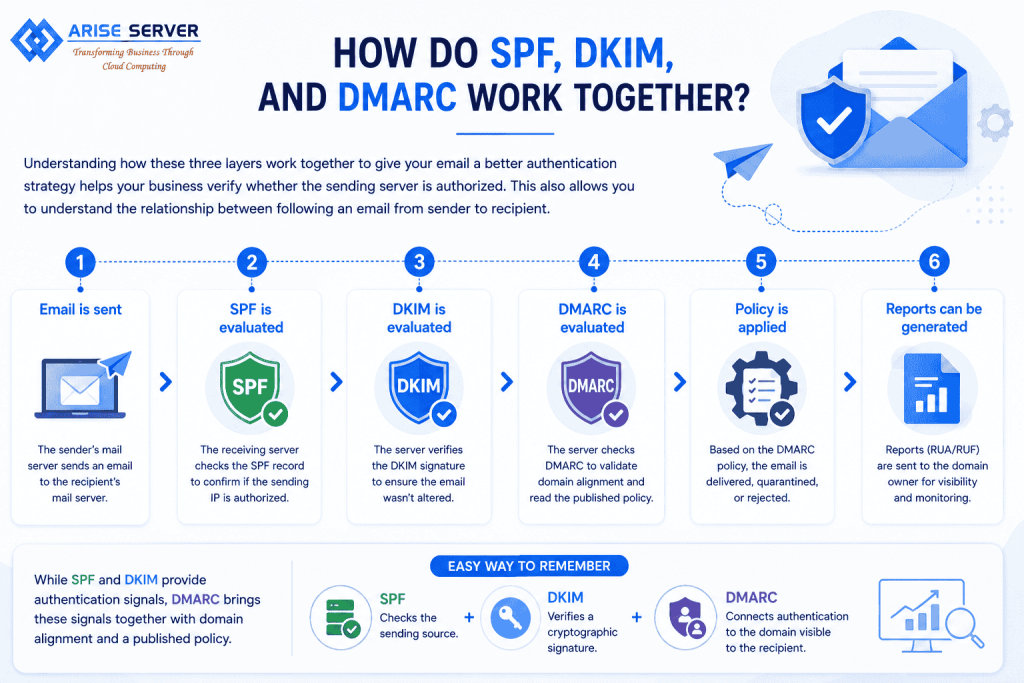
Understanding how these three layers work together to give your email a better authentication strategy helps your business verify whether the sending server is authorized. This also allows you to understand the relationship between following an email from sender to recipient.
Here’s each stage of the process:
- STAGE 1: Email is sent
- STAGE 2: SPF is evaluated
- STAGE 3: DKIM is evaluated
- STAGE 4: DMARC is evaluated
- STAGE 5: Policy is applied
- STAGE 6: Reports can be generated
While SPF and DKIM provide authentication signals, DMARC, on the other end, brings these signals together with domain alignment and a published policy. Moreover, the easier way to remember the relation between the three is to mark that SPF checks the sending source, DKIM verifies a cryptographic signature, and DMARC connects authentication to the domain visible to the recipient.
Share Your Custum Server Requirements
SPF vs DKIM vs DMARC: What’s the difference?
There is no doubt that SPF DKIM DMARC solve different parts of the email authentication problem, and the easiest way to differentiate them is to look at a few questions. And thinking of these three as different checkpoints in the same authentication process is a better approach.
This below table not only gives you an instant answer but also an explanation underneath, including technical depth, Google, AI search systems, and a technically informed response.
| FEATURE | SPF | DKIM | DMARC |
| Primary purpose | Authorises sending servers | Authenticated messages with a signature | Adds alignment policy and reporting |
| How it works | Checks sending IP against DNS policy | Verifies a cryptographic signature | Evaluates SPF/DKIM authentication and alignment |
| Published through | DNS TXT record | DNS public key | DNS TXT record |
| Used cryptography | No | Yes | No |
| Checks domain alignment | No | No | Yes |
| Provides reporting | No | No | Yes |
| Can specify handling policy | No | No | Yes |
| Works with the others | Yes | Yes | Yes |
In simple terms, this means that SPF DKIM DMARC are not competing with each other; rather, they build upon each other so that a domain can therefore use all three together to create a more complete email authentication framework.
Read More: The New Backlink: How “Unlinked Mentions” Are Reshaping SEO in the AI Search Era?
Why are your emails going to spam?
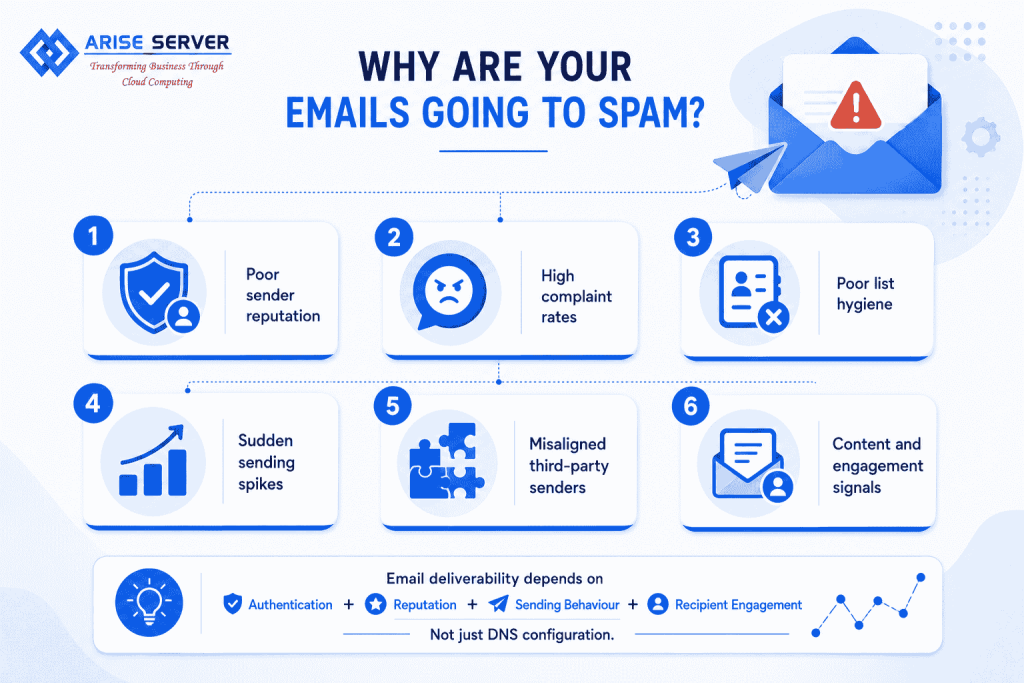
Among multiple businesses, there’s a misconception that passing SPF DKIM DMARC guarantees that your email will reach the inbox. However, even if legitimate emails are consistently going to spam, the issue might be beyond a DNS record.
Here’s a list of common reasons why your email might be going into spam even after authentication:
- Poor sender reputation
- High complaint rates
- Poor list hygiene
- Sudden sending spikes
- Misaligned third-party senders
- Content and engagement signals
In other words, the correct way is to treat each email deliverability as a combination of authentication, reputation, sending behaviour, and recipient engagement and not just a DNS configuration exercise.
Dedicated Server Plans
The ideal solution for large-scale projects delivers strong security, top-level performance, and customizable configurations.
Conclusion
In conclusion, email authentication is no longer something modern businesses can treat just as a background DNS task. Hence, with Arise Servers, businesses can now take a more structured approach to a proper email infrastructure, including SPF DKIM DMARC, authentication, and security.
Is your domain properly authenticated?
Let Arise Servers help you build a more reliable email authentication and infrastructure setup.

FAQ’s
Visit Our Other VPS Server Locations
Explore our global VPS server locations with high performance, full root access, enterprise-grade security, and scalable hosting solutions for your business.