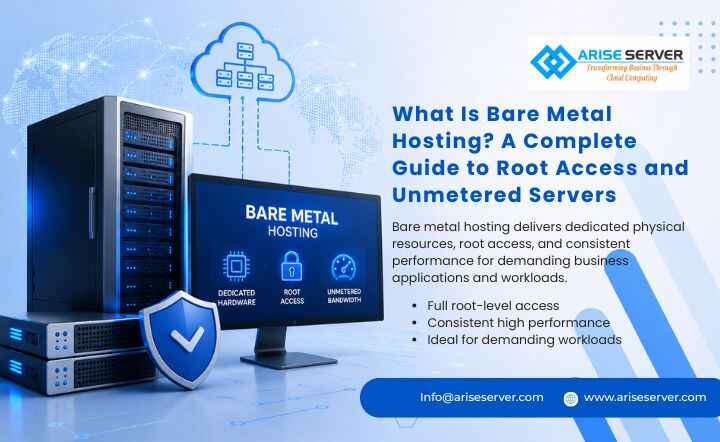
What Is Bare Metal Hosting? A Complete Guide to Root Access and Unmetered Servers
For businesses looking for more control over physical infrastructure, bare metal hosting from Arise Server provides an entire physical server dedicated to a single workload, that too without the virtualisation layer that is used to divide one machine into multiple virtual environments.
While the concept is easier than the terminology, a bare metal server is a physical machine that is assigned to one customer. And unlike a VPS, a bare metal server does not divide the underlying hardware between multiple virtual machines. Rather, you get a dedicated CPU, memory, storage, and network resources, along with root access and hosting explained in practical terms, with full administrative control over the operating system and server environments. This is what makes the technology relevant across a wide range of workloads. So, businesses running databases, GPU workloads, gaming platforms, large-scale data processing, or high-traffic applications might need consistent access to physical resources.
Having said that, how does it compare with a VPS? What does “unmetered” actually mean when a provider advertises a 1 Gbps or 10 Gbps server, and when does dedicated hardware provide a meaningful advantage rather than unnecessary infrastructure? This guide answers the same, and by the end of it, we hope you’ll have a clearer way to decide whether dedicated physical infrastructure fits your workload or not.
VPS Server Plans
An ideal VPS solution for modern projects combines strong security, high-speed performance, and flexible, scalable configurations to match your evolving requirements.
Bare metal vs virtual server: What’s the actual difference
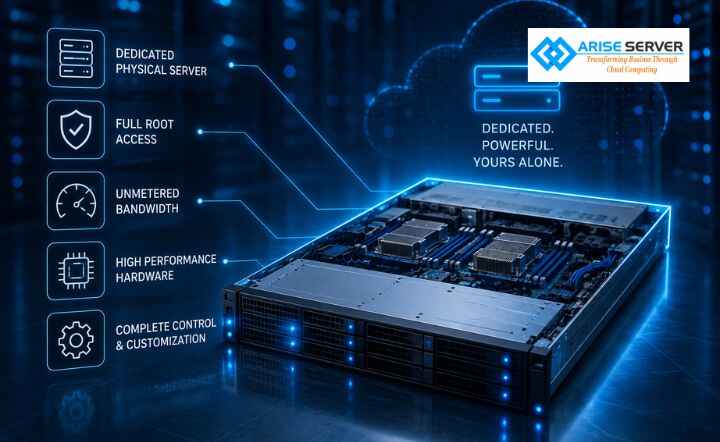
Before we move on to understanding the difference between bare metal and virtual servers, we must know what they are essentially. A bare metal server is when you rent an entire physical server for your workload, where the hardware is dedicated to you and the operating system runs directly on the machine rather than inside a virtual machine.
Read Also: 53% of Hosting Security Incidents Start with Outdated Software: Why Patch Management Isn’t Optional
Whereas a virtual server or VPS is when you rent a virtual machine created on a physical server, where a virtualization layer, usually called a hypervisor, divides the physical machine into multiple virtual environments; your VPS has its own operating system and allocated resources. Here’s a practical difference between the two:
| PARAMETERS | BARE METAL | VIRTUAL SERVER |
| Physical hardware | Dedicated to you | Shared |
| Virtualization | No traditional VM layer | Yes |
| Root/admin access | Full server-level control | Control within the VM |
| Resource allocation | Dedicated physical resources | Allocated virtual resources |
| Best suited for | High-performance, GPU, database, specialised workloads | Websites, applications, development, moderate workloads |
Additionally, a virtual server can be the practical choice when flexibility and efficient resource allocation matter more than dedicated hardware, whereas bare metal becomes more relevant when an application needs consistent access to physical resources or greater control over the underlying server.
Share Your Custum Server Requirements
What makes bare metal hosting different from shared hosting?
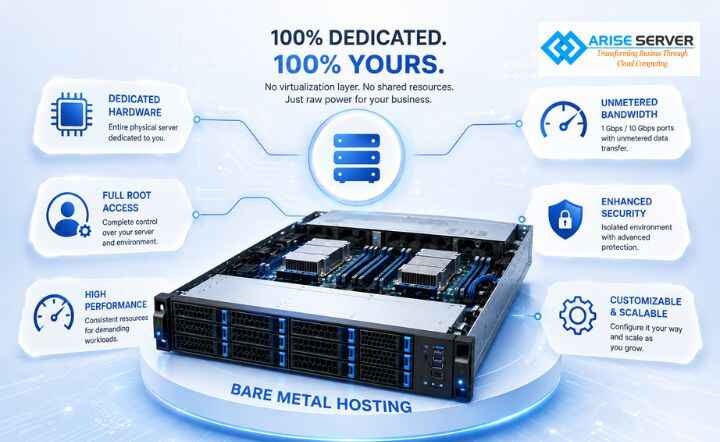
Think of shared hosting as sharing a workspace and bare metal hosting as having the entire workspace to yourself. Especially with shared hosting, several customers use the same physical server. However, when it comes to bare metal, one customer gets the complete physical machine, along with much greater control over how that server is configured and used.
Having said that, the right choice depends on how demanding your workload is and how much control your team actually needs. Here’s where the two models differ:
- Shared hardware vs. dedicated hardware: Shared hosting houses multiple customers on a single physical server. Bare metal is a single-customer physical server.
- Limited control vs root access: Shared hosting usually limits server-level changes. You get full root access and admin rights on the bare metal.
- Predefined environment versus customization: Shared hosting provides a predefined environment. Bare metal is more configurable to shape the server to your application.
- Shared resources vs. dedicated resources: With shared hosting, you are sharing a pool of server resources with other customers. With bare metal, you get the physical resources of the dedicated box.
- Basic websites and intensive workflows: Shared hosting is ideal for websites and simple applications. Bare metal is for workloads that require dedicated infrastructure and more control.
- Provider-managed environment vs. customer control: Shared hosting keeps much of the infrastructure management with the provider. Bare metal gives technical teams greater responsibility and flexibility.
Moreover, the key difference is therefore not simply performance; it is ownership of the physical resource allocation and the level of control available to the customer.
Dedicated Server Plans
The ideal solution for large-scale projects delivers strong security, top-level performance, and customizable configurations.
Is bare metal hosting right for your business?
There is no single hosting model that works for every workload. If your business needs dedicated physical hardware, full root access, greater configuration freedom, or infrastructure for demanding CPU, storage, network, or GPU workloads, bare metal hosting may be worth considering.
There is not a single hosting model that fits every workload. Bare metal hosting may be worth a look if your business needs dedicated physical hardware, full root access, more flexibility of configuration, or infrastructure to handle heavy CPU, storage, network, or GPU workloads.
So, if you have outgrown the standard hosting for your workload, check out the bare metal hosting options at Arise Server and find the infrastructure that meets your requirements
FAQ’s
Visit Our Other VPS Server Locations
Explore our global VPS server locations with high performance, full root access, enterprise-grade security, and scalable hosting solutions for your business.