
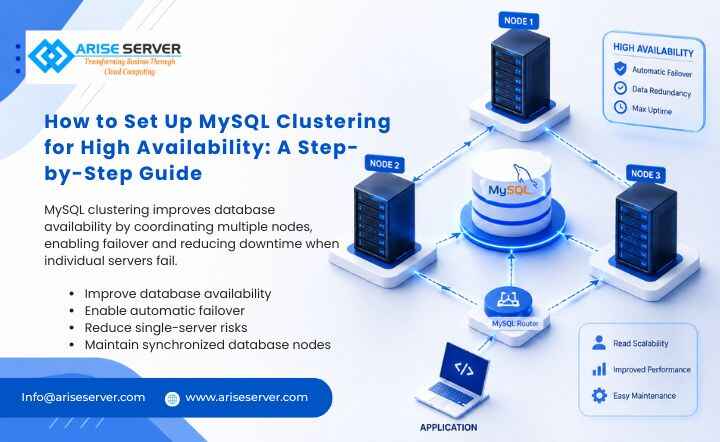
How to Set Up MySQL Clustering for High Availability: A Step-by-Step Guide
The database is down, customers cannot check out, internal systems are timing out, and nobody knows how long recovery will take. This is one of the biggest nightmares a modern business can face in this landscape. Even though your database can be perfectly healthy, properly backed up, and well monitored, it can still be your application’s single biggest point of failure.
The reason lies in relying on one MySQL server. This is because a single server concentrates your data, application dependency, maintenance window, and failure risk in one place, so if that machine goes offline, everything depending on it would go offline as well. Instead, what stands as a smart decision is to introduce multiple database nodes that work together and maintain synchronized copies of the data. However, a replica cannot automatically guarantee that your application will continue operating when the primary database disappears. This stands as a fundamental reason why organizations turn to MySQL clustering setup strategies and high-availability database hosting.
For understanding these differences, this guide takes a practical look at MySQL clustering setup, from the fundamentals of replication and failover to the real-world difference between a MySQL cluster and a single server.
What is MySQL clustering, and why does “high availability” actually mean?
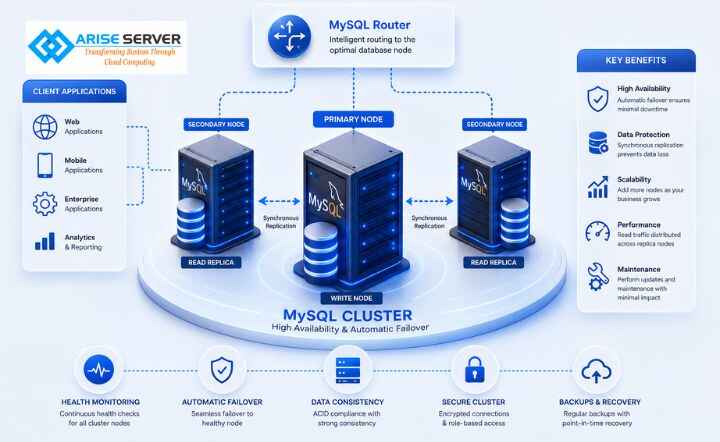
Before we move on to understanding how to set up MySQL clustering, it is essential to know what MySQL is defined as. Primarily, MySQL cluster setup is an architecture that connects multiple MySQL database instances so that they can work together to maintain data availability when an individual server fails. Data is replicated between nodes, failures can be deleted, and an appropriate node can take over depending on the clustering technology and configuration.
This is where high-availability database hosting comes in, where designing infrastructure to keep a service operational despite component failures, planned maintenance, or other disruptions is less dependent on a single machine.
VPS Server Plans
An ideal VPS solution for modern projects combines strong security, high-speed performance, and flexible, scalable configurations to match your evolving requirements.
The difference between backup, replication, and clustering:
| TECHNOLOGY | MAIN JOB | PRIMARY BENEFIT |
| Backup | Recover data | Data protection |
| Replication | Maintain another copy | Redundancy |
| Clustering | Coordinate database nodes | High availability |
Having said that, a MySQL clustering setup adds these coordination mechanisms around the database members, where MySQL InnoDB Cluster deployment and Group Replication manage the database group, while MySQL Router can direct clients to the appropriate server after topology changes.
Read Also: What Is Bare Metal Hosting? A Complete Guide to Root Access and Unmetered Servers
MySQL cluster vs. single server: What actually changes?
While the biggest difference between a MySQL cluster and a single server is not just the number of machines, a major difference lies in how the database behaves when something goes south.
Moreover, the fundamental difference in a MySQL cluster vs. single-server architecture is that a single server optimizes for simplicity, whereas a cluster optimizes for resilience.
Here’s a clear distinction between the two:
| SINGLE SERVER | MySQL CLUSTER |
| ⦁ Can make the database unavailable ⦁ Dependent on backups or separate replication ⦁ Requires recovery or promotion of another server ⦁ Database maintenance might require downtime ⦁ Costs lower | ⦁ Provides continuity depending on architecture ⦁ Multiple database members maintain replicated data ⦁ Designed to support coordinated failover ⦁ Nodes can potentially be maintained individually ⦁ Costs higher |
Apart from that, you are not just choosing between one server and several servers; rather, you are choosing between simplicity with concentrated risk and greater resilience with greater operational complexity.
Share Your Custum Server Requirements
Common mistakes that turn a cluster into a bigger outrage

There is no doubt that a MySQL clustering setup is supposed to reduce the impact of failure; if the architecture is poorly designed or poorly maintained, adding more database nodes can create more ways for an outage to happen.
Moreover, the most common mistakes that turn a cluster into a bigger outage are
- Running only two nodes
- Ignoring network latency
- Never testing failover
- Forgetting the routing layer
- Treating monitoring as optional
The common risk is that high availability depends on more than redundant hardware, as it depends on the behavior of the entire system when something changes and is is maintained with the same discipline used to build it.
Dedicated Server Plans
The ideal solution for large-scale projects delivers strong security, top-level performance, and customizable configurations.
Conclusion
In conclusion, a single MySQL server is a single point of failure, no matter how well it’s tuned, monitored, or backed up. What a well-designed MySQL clustering setup changes is what happens next: instead of a manual scramble and an extended outage, the system already knows what to do. The setup takes real planning, but so does explaining a multi-hour outage to a customer.

FAQ’s
Visit Our Other Server Locations
Explore our global dedicated server locations with high performance, strong security, and scalable configurations tailored for your business needs.