
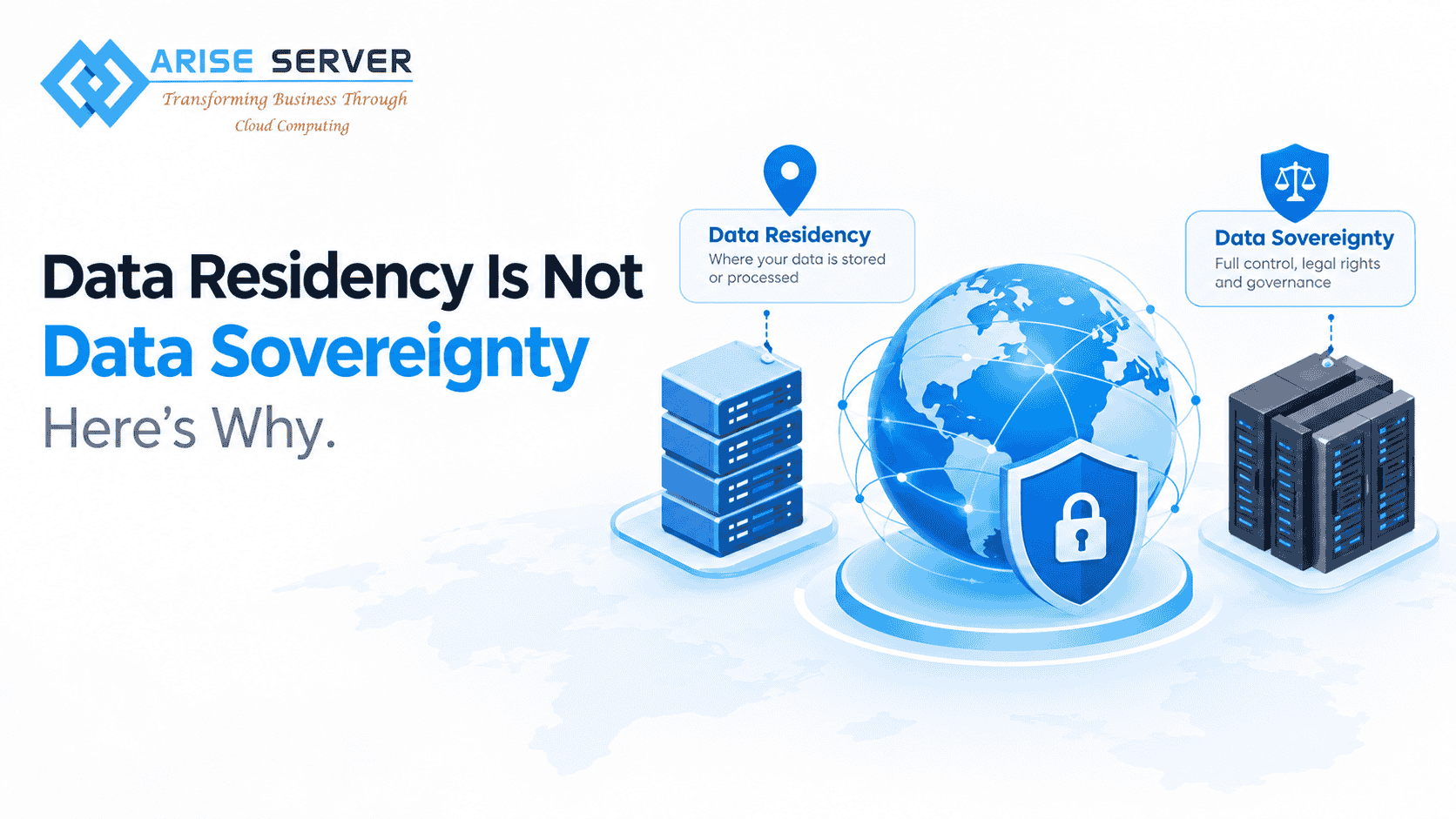
Data Sovereignty vs Data Residency: What’s Actually Different and Why Your Business Should Care?
A server sitting inside your country can create a comforting illusion of your data being local and under local control. But data sovereignty and data residency are not the same thing. As in today’s interconnected infrastructure landscape, local hosting doesn’t automatically mean local control and that’s the crucial difference between data residency and data sovereignty.
Where is your business data right now? In a cloud resign? In a backup facility thousands of miles away? And more importantly who can access it? These are the exact questions that sits at the centre of data sovereignty and data residency. Be it your customer databases, financial information, intellectual property, AI workloads and business-critical applications or hosted infrastructure, the kind of infrastructure matters the most. To that an extend where data governance cannot be separated entirely from infrastructure architecture. Which means that the choice between cloud hosting, VPS, dedicated servers and colocation can influence how much visibility and control and organisation has over its environment.
While this does not mean that one hosting model is universally right for every business, rather it means that the infrastructure like Arise Server’s should match your data, security, geographic, operational, and regulatory requirements. Which in other words means that choosing a hosting provider is more than a question of CPU, RAM, storage or uptime.
The purpose of Arise Server through this blog is to break down data sovereignty vs data residency, as we have seen most businesses use them interchangeably, explore the impact of jurisdiction and regulations like GDPR and the CLOUD Act, and daw a line on how different hosting models can affect your infrastructure strategy.
VPS Server Plans
An ideal VPS solution for modern projects combines strong security, high-speed performance, and flexible, scalable configurations to match your evolving requirements.
What is the data control stack?
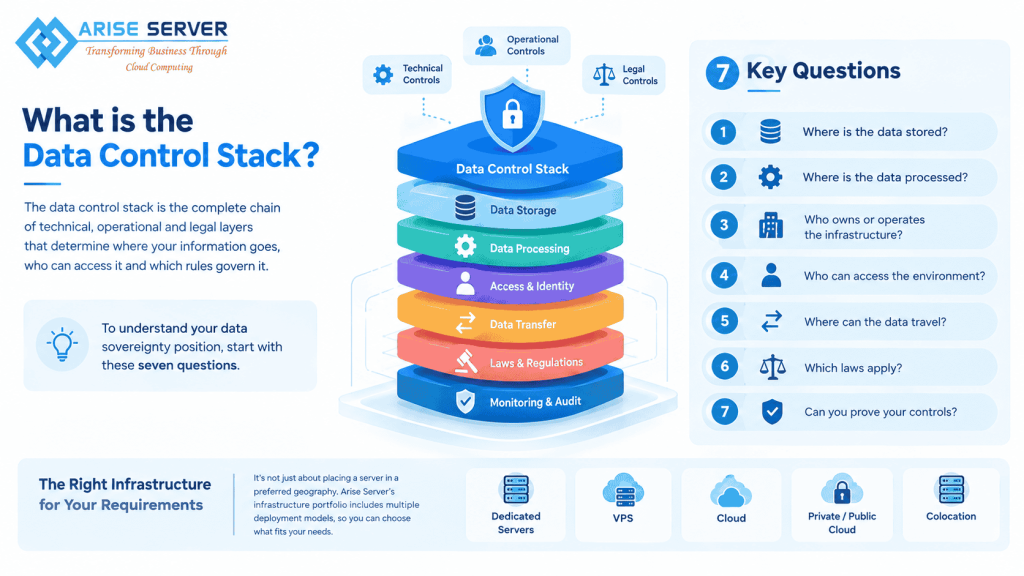
For understanding, the difference between data sovereignty and data residency is to know what exactly is a data control stack. Well, primarily data control stack is the complete chain of technical, operational and legal layers that determine where your information goes, who can access it and which rules govern it. If you want to understand your data sovereignty position, start with these seven questions:
- Where is the data stored?
- Where is the data processed?
- Who owns or operates the infrastructure?
- Who can access the environment?
- Where can the data travel?
- Which laws apply?
- Can you prove your controls?
As a business, the practical objective is not merely to place a server inside a preferred geography rather it is to understand the entire chain of controls. In Arise Server’s infrastructure portfolio includes dedicated servers, VPS, cloud, private or public cloud, which gives businesses like you multiple deployment models to estimate against your infrastructure requirements.
Where does your data reside?
Businesses who have a strict geographic requirement, infrastructure architecture should be designed intentionally. Moreover, a dedicated physical environment might offer a different control profile from a highly abstracted multi-tenant environment. Additionally, the answer to where does your data reside is not always the name of your data centre. In fact, your application might have data in several places at once.
Decoding this is exactly where data residency becomes more complicated than simply selecting a country during server deployment. Let’s see how to map every copy:
| DATA LOCATION | WHAT TO CHECK |
| Production server | Physical country or location |
| Backup server | Backup geography |
| Disaster recovery | Failover region |
| Object storage | Provider + region |
| Logs | Where logs are retained |
| Monitoring | Third-party processing |
| Support | Potential remote access |
| Replication | Cross-border movement |
This makes data sovereignty planning begin with data mapping and a simple audit. Arise Servers supports that deployment across 100+ global data-centre locations, which gives businesses the opportunity to select infrastructure locations based on workload and geographic requirements.
Dedicated Server Plans
The ideal solution for large-scale projects delivers strong security, top-level performance, and customizable configurations.
Which laws control where your data can be stored and transferred?
Now that is where, data sovereignty becomes a legal question. Where different jurisdiction imposes different rules around personal data, government access, cross-border transfers sector-specific information and data processing. If we have to break down, then let’s put it this way, the phase data sovereignty sounds technical but underneath it sits a simple question of which legal system can influence your data.
While you can simply answer, well it is under where the data sits physically. But no, the answer got way more dimensions, four in particular. Let’s have a look:
- Data location
Where is the information stored? - Data subject or customer location
Whose information is being processed and where are those individuals located? - Provider jurisdiction
Where is the hosting provider based of subject to law? - Data movement
Can the information be transferred, replicated or accessed from another country?
Moreover, under the GDRP, applicability can depend on factors including where an organisation is established and if the organisation outside the EU offers services and goods to individuals in the EU or monitors their behaviour. That is why for infrastructure planning, Arise Servers provides various deployment choices that can be assesses against your organisation’s technical and geographic requirements.
Read Also: Why Did These 10 Businesses Ditch Shared Cloud for Dedicated AI Infrastructure?
How does the data controls stack compare across different hosting models?
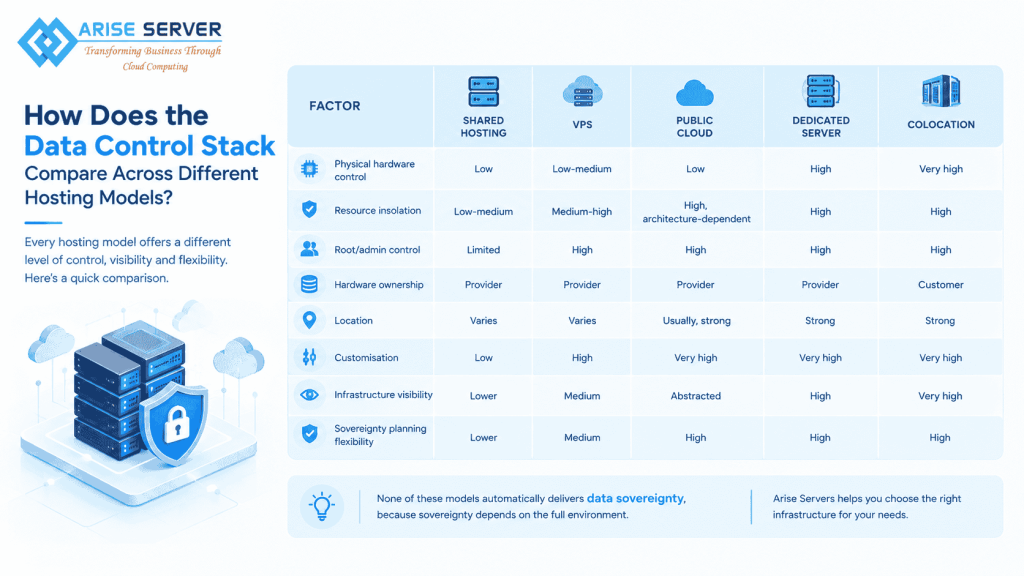
As a modern-day business in 2026 and forward, it is essential for you to understanding that every hosting model doesn’t give you the same amount of visibility so evaluating data sovereignty stands as a very important decision.
Here’s a one stop guide on hosting model comparison table:
| FACTOR | SHARED HOSTING | VPS | PUBLIC CLOUD | DEDICATED SERVER | COLOCATION |
| Physical hardware control | Low | Low-medium | Low | High | Very high |
| Resource insolation | Low-medium | Medium-high | High, architecture-dependent | High | High |
| Root/admin control | Limited | High | High | High | High |
| Hardware ownership | Provider | Provider | Provider | Provider | Customer |
| Location | Varies | Varies | Usually, strong | Strong | Strong |
| Customisation | Low | High | Very high | Very high | Very high |
| Infrastructure visibility | Lower | Medium | Abstracted | High | Very high |
| Sovereignty planning flexibility | Lower | Medium | High | High | High |
However, none of these models automatically delivers data sovereignty, because sovereignty depends on the full environment. Arise Servers helps businesses explore multiple infrastructure models under one provider.

Conclusion
In conclusion, the biggest mistake businesses make with data sovereignty is reducing it to a server-location question.
Hence, Arise Servers provides various infrastructure options from VPS and cloud hosting to dedicated servers and colocation, with global data-centre availability and infrastructure designed for demanding businesses workloads.
FAQ’s
Visit Our Other Server Locations
Explore our global dedicated server locations with high performance, strong security, and scalable configurations tailored for your business needs.