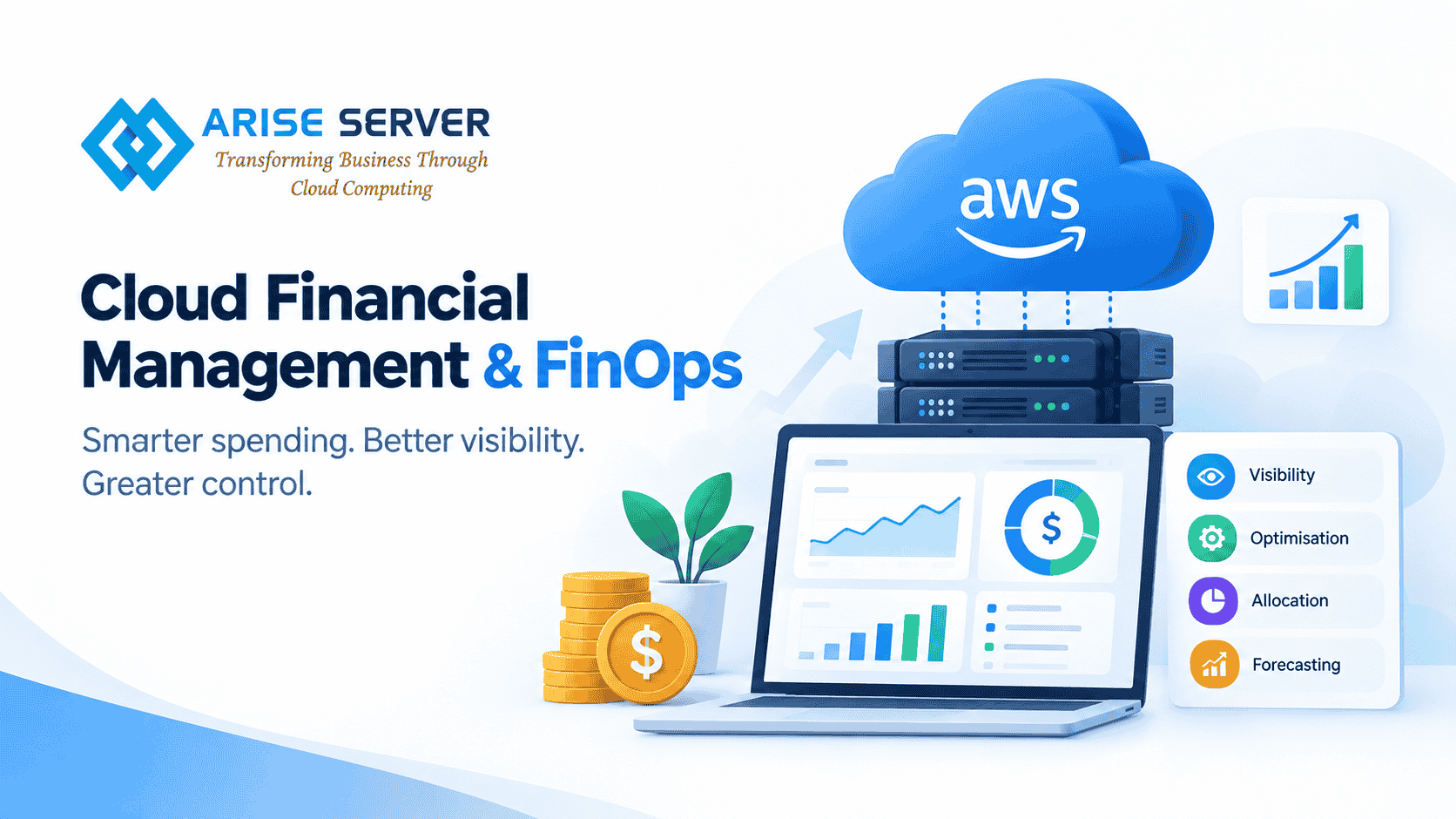
FinOps for Hosting: How to Stop Overpaying for Infrastructure You’re Not Using
The most expensive server in your cloud financial management infrastructure might be the one nobody remembers to shut down. You can have workloads running at 20%, 30%. Or 40% utilisation and still pay for the infrastructure as if it were working around the clock.
While it may sound counterintuitive especially when FinOps conversation seems to begin with another dashboard, recommendation engine, or cost-optimisation report. Surely, you can right-size instances, delete idle resources, negotiate discounts, and improve monitoring, and still be using an infrastructure model that is not financially aligned with the workload. This is why cloud financial management becomes strategic for Arise Servers. Having said that, the goal of cloud financial management is not just to make your cloud bill smaller, rather it is to make infrastructure spending more intentional this results in matching cost to utilisation, business value, performance requirements, and workload behaviour.
The objective of this blog, is to explore what is cloud financial management? where infrastructure waste typically appears, how AWS cloud financial management approaches cost visibility and optimisation, and how the top 7 cloud financial management tools for 2026 can support FinOps teams.
VPS Server Plans
An ideal VPS solution for modern projects combines strong security, high-speed performance, and flexible, scalable configurations to match your evolving requirements.
What is cloud financial management?
Copy description
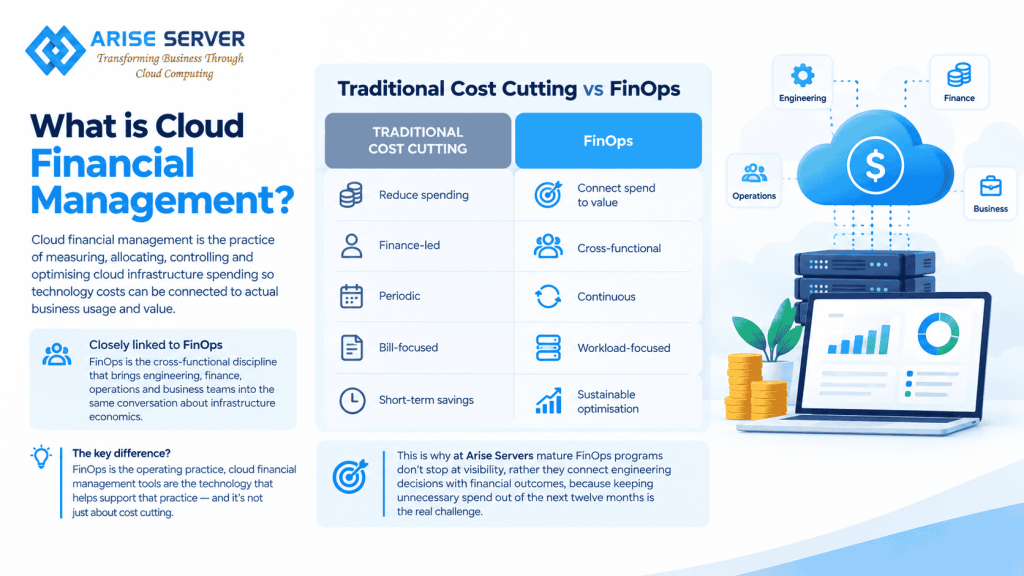
For understanding how you can stop overpaying for infrastructure, you must know what exactly is cloud financial management. Primarily, cloud financial management is the practice of measuring, allocating, controlling and optimising cloud infrastructure spending so technology costs can be connected to actual business usage and value.
While it is closely associated with FinOps, a cross-functional discipline that brings engineering, finance, operations and business teams into the same conversation about infrastructure economics. However, the important distinction is that Fin Ops is the operating practice, cloud financial management tools are the technology that helps support that practice, the cloud financial management is not just cost cutting.
Here’s a difference between traditional cost cutting and FinOps
| TRADITIONAL COST CUTTING | FinOps |
| Reduce spending | Connect spend to value |
| Finance-led | Cross-functional |
| Periodic | Continuous |
| Bill-focused | Workload-focused |
| Short-term savings | Sustainable optimisation |
This is why at Arise Servers mature FinOps programs don’t stop at visibility, rather they connect engineering decisions with financial outcomes, because common keeping unnecessary spend out of the next twelve months is the real challenge.
Can AWS cloud financial management prevent overspending?
Well yes, but it cannot guarantee that overspending will never happen. AWS cloud financial management gives teams the visibility and controls needed to detect unusual spending, monitor budgets, analyse usage, forecast costs, and identify optimisation opportunities.
However, AWS Budgets lets teams establishes spending thresholds, and Cost Anomaly Detection can identify unusual spending patterns. The bigger approach is to connect these tools to an ongoing FinOps process. Here’s what a practical cloud financial management workflow might look like:
| STAGE | QUESTIONS |
| Measure | What are we spending? |
| Detect | Where is spending changing? |
| Investigate | Why did it change? |
| Optimise | What can we safely reduce? |
Having said that, a workload might be optimised repeatedly and still remain expensive if its infrastructure model doesn’t match its behaviour. For Arise Servers cloud financial management is not just a collection of billing tools, rather it is a discipline for turning infrastructure spending data into better decisions.
Read Also: Data Sovereignty vs Data Residency: What’s Actually Different and Why Your Business Should Care?
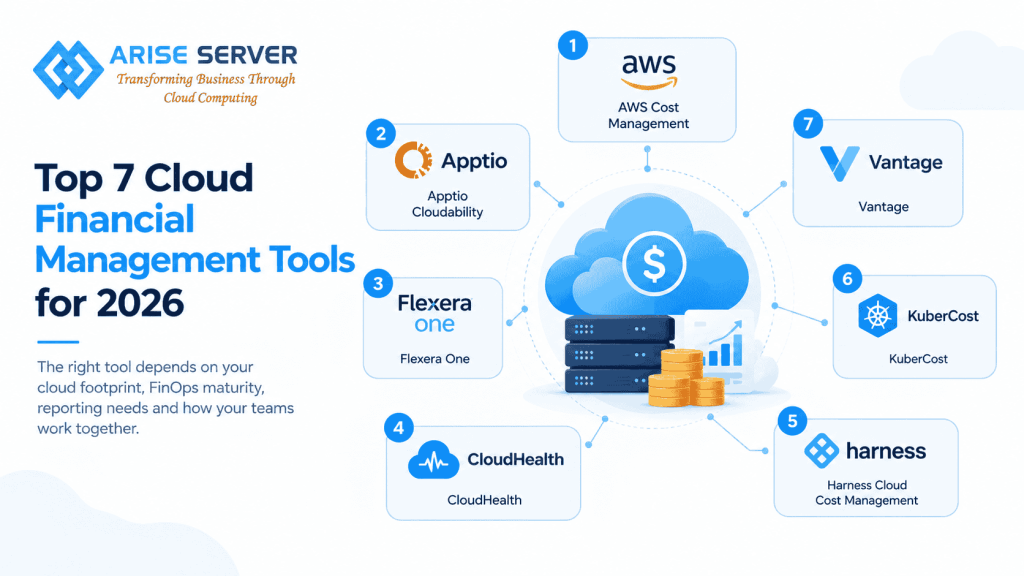
What are the top 7 cloud financial management tools for 2026?
Copy description
While there is no one universal best cloud financial management tool, as per Arise Servers, the right platform depends on your cloud footprint, FinOps maturity, reporting requirements, Kubernetes usage, commitment strategy, and how deeply finance and engineering need to collaborate.
Here’s the top 7 cloud financial management tools for 2026:
- AWS cost management
- Apptio cloud ability
- Flexera one
- Cloud Health
- Harness cloud cost management
- Kuber cost
- Vantage
These tools are what makes best cloud financial management tools reviews 2026 useful for a not a generic ranking, but a framework for matching capabilities to your operating model.
Dedicated Server Plans
The ideal solution for large-scale projects delivers strong security, top-level performance, and customizable configurations.
Does every workload need elastic cloud?
No, that’s not an argument against cloud. Rather a workload’s infrastructure requirements are shaped by several factors like traffic variability, compute intensity, storage growth, latency requirements, availability objectives, deployment patters, and how frequently capacity needs to change. Now this automatically doesn’t make dedicated hosting or VPS hosting the right answer. Here’s a practical FinOps test:
- Measure utilisation
- Identify variability
- Separate baseline from peaks
- Calculate the cost of flexibility
- Compare infrastructure models
Moreover, the smartest infrastructure strategy is the one where the infrastructure matches the workload.

Conclusion
In conclusion, cloud financial management gives businesses visibility, while FinOps adds ownership and accountability. So if your workload is unpredictable, elastic cloud can be extremely useful.. Hence, if you like to see what that comparisons looks for your workload, talk to the Arise Servers team about right -sizing your infrastructure spend.
FAQ’s
Visit Our Other VPS Server Locations
Explore our global VPS server locations with high performance, full root access, enterprise-grade security, and scalable hosting solutions for your business.