Server Bandwidth vs Data Transfer: How Much Does Your Website Actually Need?
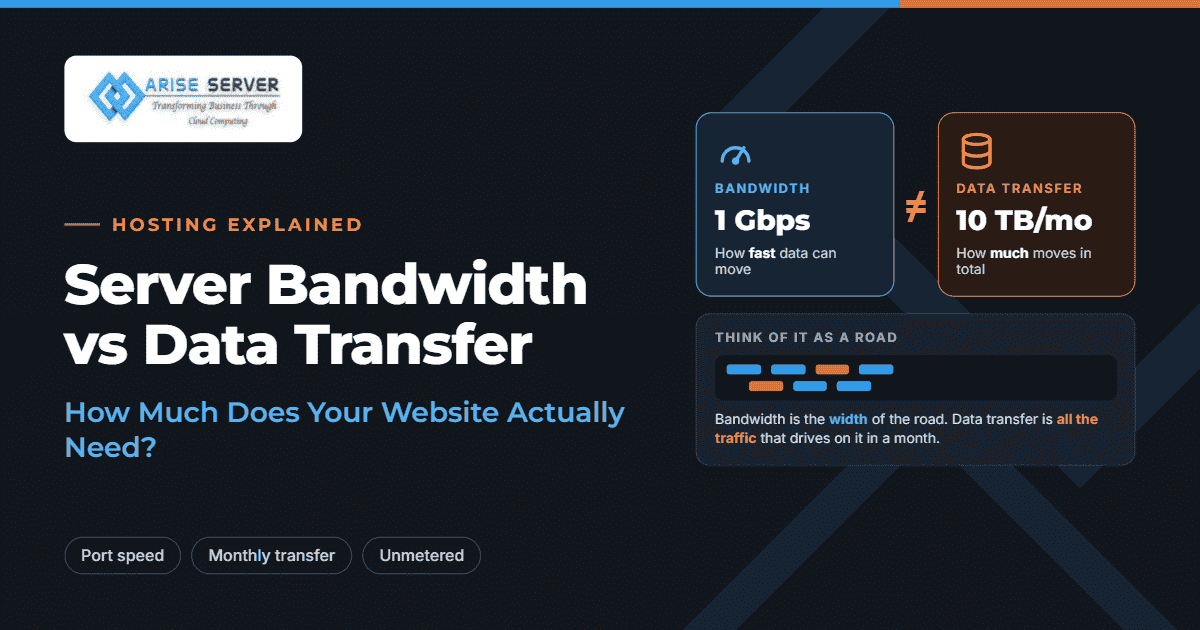
Few hosting terms are used as loosely as server bandwidth, and that confusion often leads to plans that are either too tight for a busy day or far larger than the business will ever use. At Arise Server, we regularly meet customers who compare a 1 Gbps port with a 10 TB monthly allowance as if they were the same thing, when they measure two very different limits.
Well, one number describes how fast data can move, and the other describes how much can move in total. Apart from that, you also need to know that “unmetered” does not always mean “unlimited”, and a fast port does not guarantee a fast website if the application behind it is slow.
With this blog, Arise Server aims to guide you through how bandwidth differs from data transfer, how to calculate both for your own site, and how to read hosting plans so you pay for the capacity you will actually use.
What is server bandwidth?
Before we begin the maths, let’s start with the basics. Server bandwidth is the maximum rate at which data can travel to and from your server, usually measured in Mbps or Gbps. Think of it as the width of a road, since a wider road lets more vehicles pass at the same moment.
Be it a product catalogue, a video library, a software download page, or a customer portal, every visit pulls files, images, and responses through that connection.
Here’s what server bandwidth affects in daily use:
• Page load speed during busy periods
• Download and streaming quality
• Backup and file transfer times
• API and application response
Moreover, bandwidth is a ceiling, not a promise. If your traffic never reaches the ceiling, a bigger port will not make the site faster.
VPS Server Plans
An ideal VPS solution for modern projects combines strong security, high-speed performance, and flexible, scalable configurations to match your evolving requirements.
How is bandwidth different from data transfer?
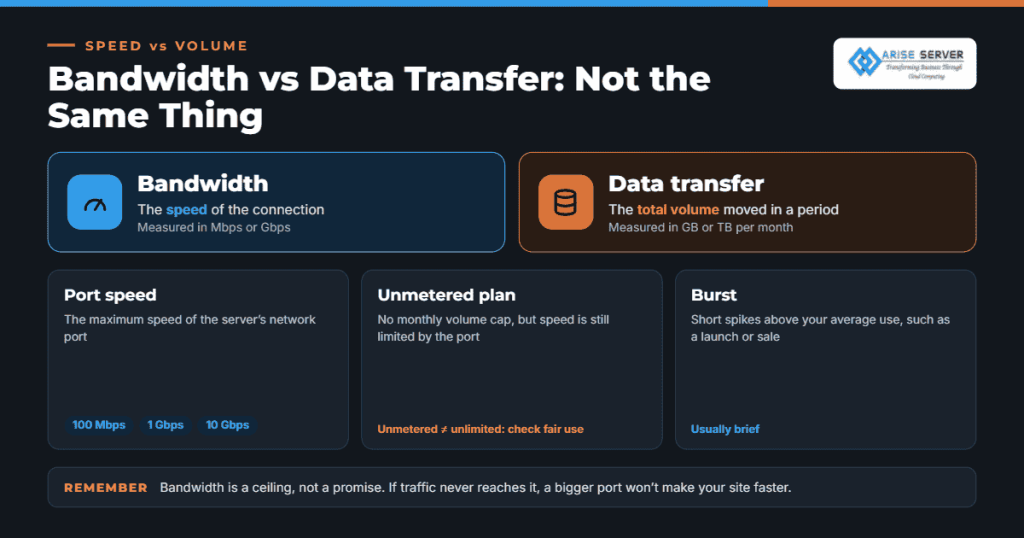
| TERM | WHAT IT MEASURES | TYPICAL UNIT |
| Bandwidth | Speed of the connection | Mbps or Gbps |
| Data transfer | Total data moved in a period | GB or TB per month |
| Port speed | Maximum speed of the network port | 100 Mbps, 1 Gbps, 10 Gbps |
| Unmetered plan | No monthly volume cap | Speed limited by port |
| Burst | Short spikes above average use | Often brief |
Having said that, plans differ in how they handle limits, so always check whether a fair-use policy, a cap, or a reduced speed applies after a threshold.
Why does it matter to size bandwidth correctly?
When a launch page crawls during a promotion or a download stalls at 90%, visitors rarely wait. So, when you size server bandwidth properly, you protect the experience your traffic depends on.
Moreover, both oversizing and undersizing cost money. Understand the trade-off through these signals:
• Average and peak traffic
• Average page or file size
• Share of media and downloads
• Use of a CDN or caching
• Expected growth over the next year
Arise Server provides hosting options with different port speeds and transfer allowances, so you can align your plan with measured requirements instead of guesswork.
Dedicated Server Plans
Arise Dedicated Servers deliver powerful performance, reliable infrastructure, and flexible resources for businesses, high-traffic websites, applications, and demanding workloads.
How do you calculate the bandwidth you need?
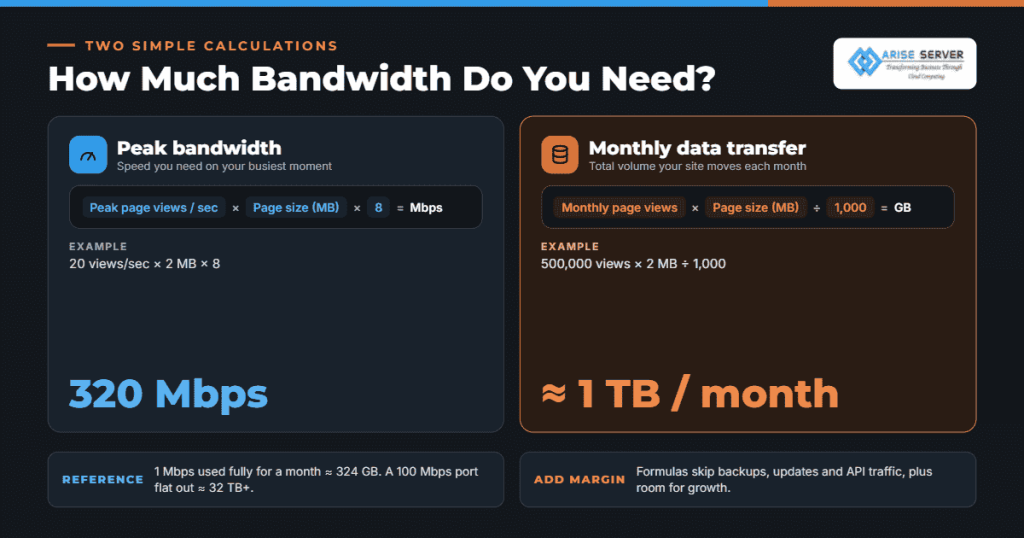
Now that we know the difference, let us move on to two simple calculations, one for speed and one for volume.
FORMULA:
• Peak bandwidth (Mbps) = Peak page views per second X Page size (MB) X 8
• Monthly data transfer (GB) = Monthly page views X Page size (MB) / 1,000
For example, if your site handles 20 page views per second at peak and each page weighs 2 MB, the peak need is 20 X 2 X 8, which equals 320 Mbps. If the same site serves 500,000 page views a month, monthly transfer is about 1,000 GB, or 1 TB.
Now, this does not include backups, updates, or API traffic, so add a margin for those. As a reference, a connection used fully at 1 Mbps for a month moves roughly 324 GB, which means a 100 Mbps port running flat out could move over 32 TB. At Arise Server, we can use this process to measure average and peak traffic, estimate page weight, add a safety margin, compare plans, and revisit the numbers as the site grows.

Conclusion
In conclusion, understanding server bandwidth means separating speed from volume, measuring your real traffic, and choosing a plan that leaves sensible room to grow without paying for unused capacity.
Hence, at Arise Server, our goal is not to give you the biggest connection available but to help you select infrastructure that meets your requirements today and leaves room for tomorrow’s growth.
FAQ’s
Visit Our Other Server Locations
Explore our global dedicated server locations with high performance, strong security, and scalable configurations tailored for your business needs.