Server Clustering for High Availability: Benefits, Types, and Real-World Uses of Keeping Your Business Online
Your website is processing orders, your application is serving customers, your database is handling critical transactions, and then one server stops responding. That’s where server clustering helps businesses prepare for that moment by allowing multiple nodes to work together, and, where the architecture supports it, move services away from a failed node.
But as we have seen at Arise Servers, adding another server is not enough; instead, effective high availability requires coordinated systems, reliable monitoring, sensible failover rules, and a plan for protecting data when something goes wrong. Especially for businesses depending on online transactions, customer portals, databases, and internal applications, that capability can be central to business continuity. However, adding another server is not enough for effective high availability, which requires coordinated systems, reliable monitoring, sensible failover rules, and a plan for protecting data.
Having said that, what is server clustering, and how does it support business continuity? What downtime can cost your organization? How do cluster nodes, heartbeats, failover, quorum, and fencing work? How to approach server clustering planning and budgeting? And what is the true difference between server clustering vs. dedicated servers?
This article explores the same questions for a modern-day business and tries to identify what must stay online, understand the risks, and select infrastructure that is designed around your unique and actual recovery needs with Arise Servers.
What is server clustering, and why is it important for business continuity?
For understanding the benefits, types, and real-world uses, it is essential to understand what is server clustering. Primarily, server clustering is an architecture in which two or more servers work together to provide a service, share processing tasks, or maintain availability when individual components fail.
Server clustering holds importance for businesses because continuity depends on more than raw server performance. For example, if a critical application runs on one machine and that machine fails, users may lose access until the issue is resolved.
That’s where a properly designed cluster can reduce that dependency by providing an alternate node and a defined recovery process.
Here are a few major business benefits of server clustering:
- Reduced single points of failure
- Improved availability
- Flexible capacity
- Planned maintenance
- Stronger continuity planning
Having said that, clustering does not eliminate downtime from every network, storage, software, or site-level failure. With Arise Servers, the right investment is not just about more hardware; rather, it is about a carefully planned availability plan that matches the business impact of downtime.
VPS Server Plans
An ideal VPS solution for modern projects combines strong security, high-speed performance, and flexible, scalable configurations to match your evolving requirements.
How much does server downtime cost your business?
Even though a server outage can affect far more than the application that stops responding, the team might still need to validate data, restart dependent services, and reassure customers.
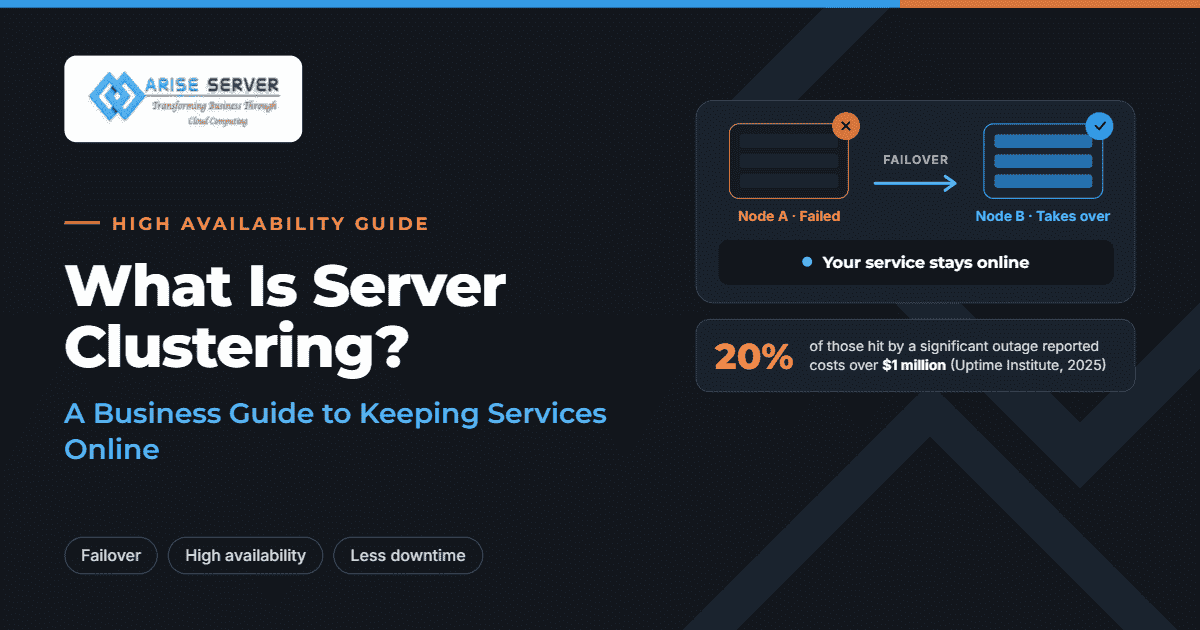
Having said that, a 2025 Uptime Institute survey has found that 20% of respondents who experienced a significant data centre outage reported costs exceeding $1 million.
Which means that the cost of downtime is rarely limited to the server repair bill.
Here’s how you can estimate your business impact using this checklist:
| COST CATEGORY | WHAT TO MEASURE |
| Lost revenue | Orders or billable activity missed during the outage |
| Productivity | Employees unable to complete essential work |
| Recovery | IT labour, troubleshooting, and restoration |
| Customer impact | Delayed service, refunds, or churn |
| Contractual exposure | Applicable SLA credits or penalties |
| Data impact | Lost, duplicated, or inconsistent transactions |
However, not every workload requires a high-availability cluster, so the investment should match the impact and likelihood of failure. So before investing in server clustering planning, you must establish how quickly each application must recover and how much data loss is acceptable.
How does server clustering work to prevent downtime?
Now that we understand what server clustering is and how it impacts your business, the next step is to know how it works.
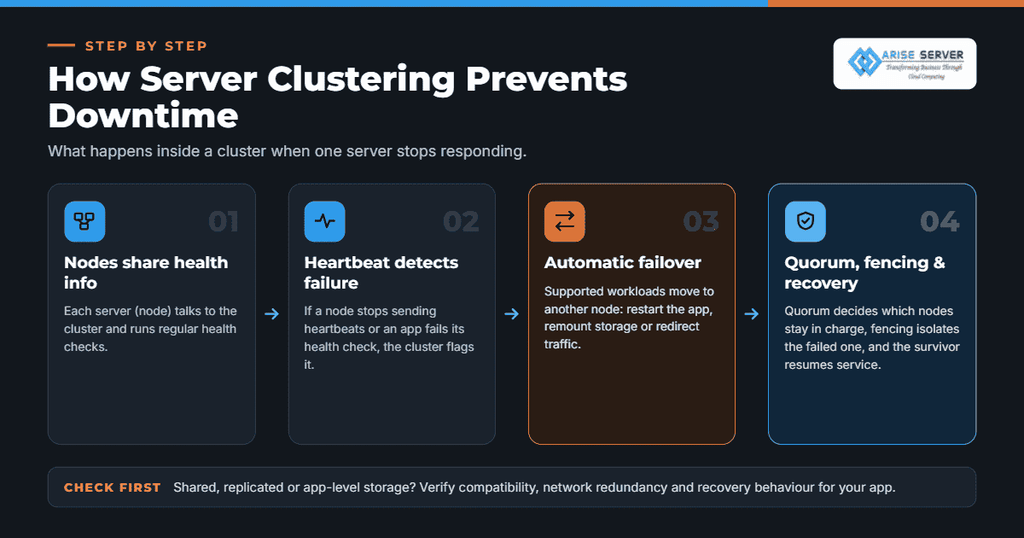
Let’s understand the same through these steps:
Cluster nodes
The nodes share health information, where each node participates in cluster communication and runs configured health checks
Heartbeat detects server failures
At this stage, the problem is detected where if a node stops sending heartbeats or an application fails its health check, the cluster estimates the condition.
Automatic failover
After that, when the cluster confirms that a node or service is unavailable, it moves supported workloads to another node. This means that the recovery process might involve restarting an application, remounting storage, or redirecting traffic.
Quorum and fencing
The final stage is workload recovery, where the surviving node starts or assumes the application, reconnects required resources, and resumes services.
Having said that, server clustering and how it works depends on the platform as well. Some clusters use shared storage; others use replicated storage or application-level replication. So, before choosing, verify compatibility, storage architecture, network redundancy, and recovery behaviour for your specific application.
Dedicated Server Plans
Arise Dedicated Servers deliver powerful performance, reliable infrastructure, and flexible resources for businesses, high-traffic websites, applications, and demanding workloads.
What are the different types of server clusters?
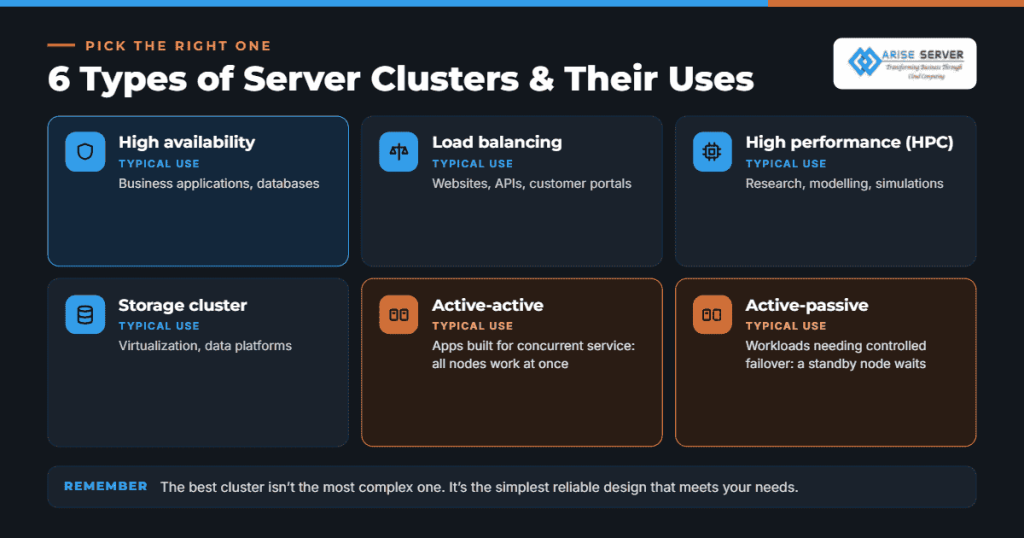
As we know, not every cluster solves the same problem; the goal is to be able to differentiate between different types of server clusters and their specific role in your business.
The common types of server clustering are:
| CLUSTER TYPE | TYPICAL USE |
| High availability | Business applications, databases |
| Load balancing | Website, APIs, customer portals |
| High performance computing | Research, modelling, simulations |
| Storage cluster | Virtualization, data platforms |
| Active-active | Applications designed for concurrent services |
| Active-passive | Workloads requiring controlled failover |
The best cluster is not the most complex one; rather, it is the simplest reliable design that meets your availability needs and performance objectives.

Conclusion
In conclusion, server clustering is more than a way to connect multiple servers. The key is choosing an architecture that matches the workload. Be it a high-availability cluster or a high-performance cluster, each approach has different requirements for storage, networking, software, and administration.
Hence, Arise Servers offers infrastructure options including dedicated servers, private cloud, on-premises cloud, and colocation.
FAQ’s
Visit Our Other Server Locations
Explore our global dedicated server locations with high performance, strong security, and scalable configurations tailored for your business needs.