What Is Bandwidth Throttling and How Does It Happen?
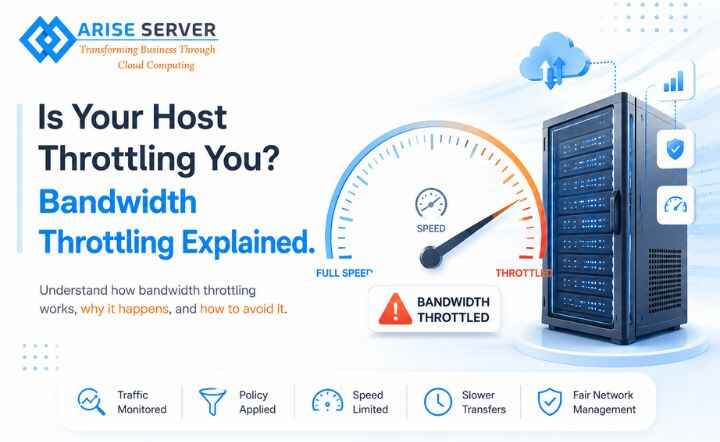
Your hosting plan might promise a high-speed connection, yet large file transfers can crawl, applications can become slow, and bandwidth throttling might be one of the reasons behind it. Having said that, when a provider, network administrator, or hosting company deliberately limits how quickly data can move across a connection, the slowdown might look like a server problem, congestion, or even a faulty application.
Whereas the tricky part is that bandwidth throttling does not always announce itself. You might not see an error message telling you that your connection has been restricted. A connection might deliver high speed under normal conditions and then become noticeably slower after a usage threshold, especially during busy periods or when certain types of traffic are identified. And for businesses running websites, applications, databases, backups, media platforms, or data-heavy workloads, that difference can have a direct impact on performance. Be it a website server, a large asset, or an application exchange, businesses are increasingly depending on continuous transfers. So, if performance consistently drops after a particular amount of usage, at certain times, or under specific traffic conditions, the bandwidth throttling policy needs closer attention.
This blog aims at understanding bandwidth throttling, how providers identify traffic that meets their throttling criteria, what throttling is used for, and how it affects real-world server performance.
How does bandwidth throttle limit connection speed?
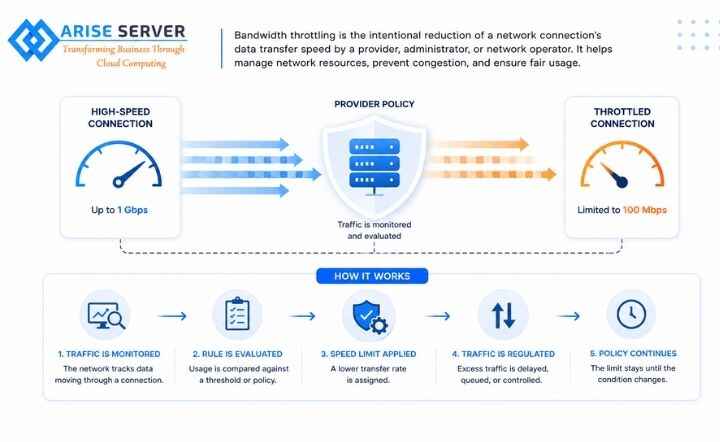
Before we move on to understanding how bandwidth throttling limits your connection speed, it is essential to know what bandwidth throttling is exactly. Primarily, bandwidth throttling is the intentional reduction of a network connection’s data transfer speed by an internet service provider, hosting provider, network administrator, or other network operator. For example, if a server has a 1 Gbps network connection but a traffic policy limits its throughput to 100 Mbps, the server might still have a 1 Gbps-capable connection, but its traffic is being throttled to the lower rate.
Moreover, bandwidth throttling limits connection speed by deliberately controlling the rate at which data is allowed to pass through a network connection. So instead of allowing traffic to use the full available capacity, a provider or network administrator applies a lower-transfer rate limit to a connection, account, application, protocol, or type of traffic.
Here’s how bandwidth throttling limits connection speed:
| STAGE | WHAT HAPPENS |
| Traffic is monitored | The network tracks data moving through a connection or account |
| A rule is evaluated | Usage is compared against a configured threshold, policy, or traffic condition |
| A speed limit is applied | The connection is assigned a lower permitted transfer rate |
| Traffic is regulated | Data continues to flow, but excess traffic is delayed, queued, or otherwise controlled rather than being transmitted at the connection’s full potential. |
Additionally, the practical effect is easiest to see when a workload needs sustained throughput where a large backup, software distribution job, database transfer, media upload, or server-to-server synchronization might take substantially longer once the permitted transfer rate is reduced.
This is also why a speed test alone does not always prove that throttling is occurring or identify a pattern; it is more useful to compare transfer speeds across different times, workloads, and usage levels while also checking the provider’s bandwidth policy.
VPS Server Plans
An ideal VPS solution for modern projects combines strong security, high-speed performance, and flexible, scalable configurations to match your evolving requirements.
How do providers detect and apply throttling?
A throttled connection usually starts with a simple question inside the network, and when a connection suddenly becomes slower after heavy usage, it is natural to assume that something has failed. Because the provider might simply have detected a particular traffic condition and applied a bandwidth policy.
Read More: What Is a CDN? A Beginner’s Guide to Content Delivery Networks
These rules can be based on data, comparing usage against predefined rules; these rules can be based on data consumption, connection speed, traffic type, account-level limits, or periods of high network demand.
Here’s how providers detect and apply bandwidth throttling:
| STAGE | PROVIDER ACTION | EFFECT ON TRAFFIC |
| Monitor | Measures traffic moving through the network | Establishes current usage |
| Classify | Associates traffic with an account, server, application, or traffic category | Determines which policy applies |
| Evaluate | Checks traffic against configured rules | Determines whether a limit should apply |
| Throttle | Enforces a maximum transfer rate | Reduces permitted throughput |
| Monitor again | Continues tracking traffic | A restriction can remain until the policy condition changes |
Apart from this, a common mechanism is rate limiting, where the network establishes a maximum transmission rate. The network might simply be congested.
hare Your Custum Server Requirements
What is the difference between throttled and unmetered bandwidth?
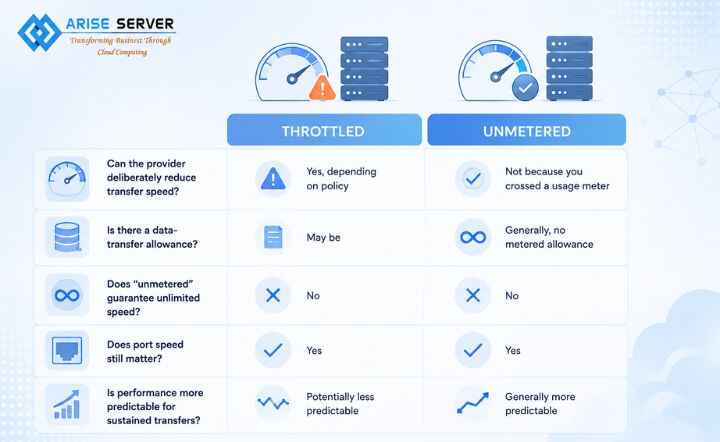
The key difference is how the provider handles data transfer, where throttled bandwidth means the provider deliberately limits the speed at which data can move, whereas unmetered bandwidth means there is no usage-based data transfer cap or automatic slowdown tied to how much data you consume, although the connection still has a defined port speed.
| QUESTION | THROTTLED | UNMETERED |
| Can the provider deliberately reduce transfer speed? | Yes, depending on policy | Not because you crossed a usage meter |
| Is there a data-transfer allowance? | May be | Generally, no metered allowance |
| Does “unmetered” guarantee unlimited speed? | No | No |
| Does port speed still matter? | Yes | Yes |
| Is performance more predictable for sustained transfers? | Potentially less predictable | Generally more predictable |
In a way, describing data transfer that is not restricted by a conventional usage meter, subject to the provider’s started service conditions and the capacity of the connection.
Dedicated Server Plans
The ideal solution for large-scale projects delivers strong security, top-level performance, and customizable configurations.
Conclusion
In conclusion, a slow transfer does not always mean your server is underpowered or your network is failing. Sometimes the infrastructure has available capacity, but a bandwidth policy is preventing you from using it fully. That is the fundamental idea behind throttling.

FAQ’s
Visit Our Other Server Locations
Explore our global dedicated server locations with high performance, strong security, and scalable configurations tailored for your business needs.