
What Is Colocation Hosting? Why Are Smart Companies Moving Their Servers to Professional Data Centre?
The next competitive advantage your business gains probably won’t come from buying faster servers. It’s come from deciding where servers live. This is a remarkable shift that Arise Server has witnessed in how businesses today think about and invest in IT infrastructure.
While the industry believes that the biggest infrastructure investment is the hardware sitting in their server racks, the real investment lies in everything required to keep them operational. Be it power, cooling, physical security, network redundancy, compliance, disaster recovery, maintenance, and more. As AI, edge computing, hybrid cloud, and stricter data sovereignty regulations reshape enterprise technology, colocation hosting is that one infrastructure model that is becoming indispensable. Having said that, the shift is not just about reducing costs but also the flexible support a modern infrastructure requires to navigate growing concerns around data compliance, hosting, and long-term scalability.
So, whether you are comparing colocation vs. cloud, evaluating colocation data centre pricing, or simply exploring the benefits of colocation, the real question lies in whether your business needs servers or to innovate faster, scale confidently, and compare more effectively in an increasingly digital world. Read along to know!
What is colocation hosting, exactly?
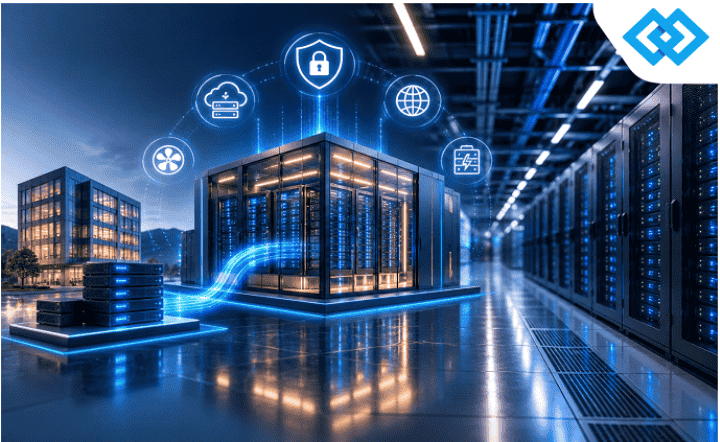
Before we move on to understand why smart businesses are moving their servers to professional data centres, it is essential to understand what colocation hosting is exactly. Primarily, colocation hosting is a service that allows businesses to place their own servers, storage systems, and networking equipment inside a professionally managed, third-party data centre instead of maintaining them in an in-house server room. One such data centre is Arise Server, which allows you to keep the complete ownership and control of your hardware while building an enterprise-grade infrastructure.
Read Also: Why NVMe VPS Hosting Is Faster Than SSD Hosting
While colocation hosting allows businesses to house their servers and networking equipment inside a professionally managed Tier 3 data centre, colocation hosting servers, unlike traditional hosting services, include advanced cooling systems, physical security, carrier-grade connectivity, and data centre redundancy. No doubt that many facilities operate as carrier-neutral data centre, allowing customers to choose from multiple internet service providers for improved performance. Here’s what collocation hosting typically offers:
⦁ Secure rack space for your servers and networking equipment
⦁ Redundant power infrastructure, including UPS systems and backup generators
⦁ Advanced cooling and environment monitoring
⦁ High-speed internet with multiple carrier options
⦁ Physical security, CCTV surveillance, biometric access, and fire suppression
⦁ Remote hands support for hardware maintenance and troubleshooting
⦁ Scalable rack space hosting as your infrastructure grows
So, whether you are running enterprise applications, private cloud environments, GPU colocation for AI workloads, or supporting edge computing data centres, colocation hosting offers your business a balance of control, reliability, and scalability that many businesses struggle to achieve with an in-house server room.
Dedicated Server Plans
The ideal solution for large-scale projects delivers strong security, top-level performance, and customizable configurations.
What does running your own server room actually cost?
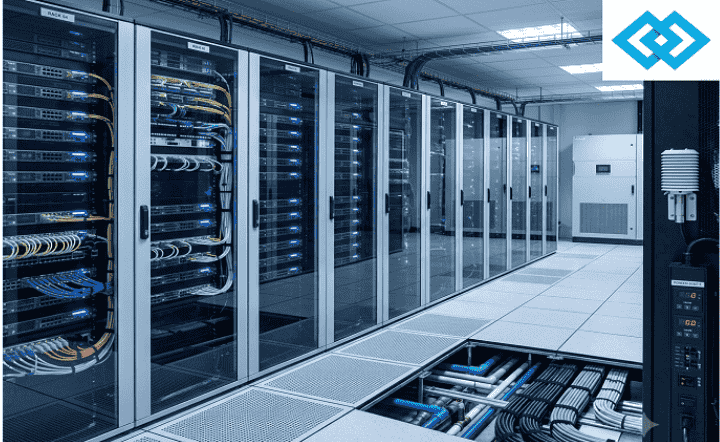
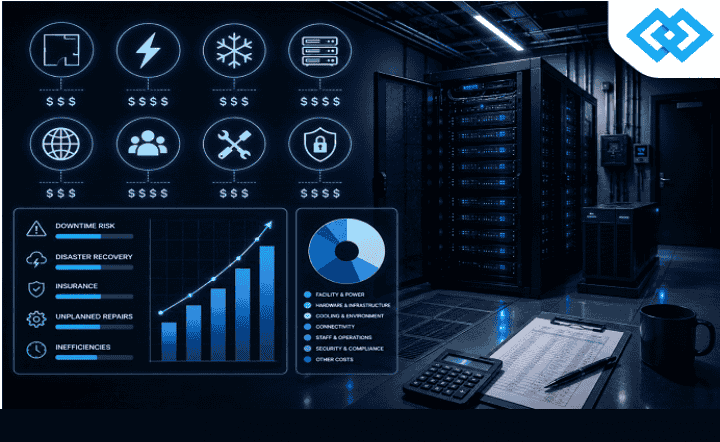
One of the major reasons the debate has shifted from server room vs. data room to finding the right infrastructure strategy for long-term business growth is the logistics involved. What we have seen at Arise Server is that organizations often budget for hardware but underestimate the long-term operational costs of maintaining an in-house server room. However, on paper, running your own infrastructure may appear cost-effective, while the total cost of ownership (TCO) is often much higher than expected.
Where research shows that operational and personal expenses often account for 50-80% of total infrastructure costs, here are some of the hidden infrastructure costs where a business’s budget grows:
⦁ Power infrastructure
⦁ Cooling systems
⦁ Physical security
⦁ Network redundancy
⦁ IT staffing
Having said that, the biggest problem with an in-house server room isn’t that it fails every day; rather, it’s that failures are unpredictable. That’s where the benefits of colocation become clear, as managed colocation services significantly reduce operational risk while improving scalability.
Share Your Custum Server Requirements
Why is the traditional server room model breaking?
Undoubtedly, the traditional server room wasn’t built for the modern-day digital economy that we operate in. At Arise Server, we have seen a clear shift in how organizations approach infrastructure, and what once served as a practical solution for storing servers has become increasingly difficult to justify as businesses adopt AI, hybrid cloud, edge computing, and always-on digital operations.
While a small server room with basic cooling, a UPS, and a single internet connection was enough years ago, today the same infrastructure needs to support cloud-connected applications, cybersecurity, monitoring, real-time analytics, video collaboration, AI processing, and business-critical workloads that simply cannot afford downtime. Which, in turn, has raised the move away from conventional server rooms.
Here’s why the traditional server room model is breaking:
⦁ AI and GPU-intensive workloads
⦁ Growing cybersecurity threats
⦁ Data sovereignty and compliance
⦁ Business continuity expectations
⦁ Scalability challenges
Apart from this, the biggest challenge is that most office server rooms depend on limited power infrastructure, a single internet provider, and standard commercial cooling systems. That is why professional Tier 3 data centre colocation facilities like Arise Server are designed with N+N power redundancy, multiple network carriers, precision cooling, and robust physical security to minimize downtime.
VPS Server Plans
An ideal VPS solution for modern projects combines strong security, high-speed performance, and flexible, scalable configurations to match your evolving requirements.
The rise of AI is changing infrastructure in-house
In between the digital operations, AI is also fundamentally changing the infrastructure that powers modern businesses. Instead, businesses today rethink where their servers should live as AI, machine learning, big data, and real-time analytics dramatically increase the demand for computing power.
However, the traditional office server rooms were created to support email, databases, file storage, and business applications, but AI introduces an entirely different level of complexity where training LLMs, running AI inference, processing massive datasets, and supporting advanced analytics require much more power, cooling, networking, and storage than the traditional applications.
In fact, the rise of AI is driving businesses towards colocation hosting, where enterprise-grade infrastructure is purpose-built to handle high-density computing while maintaining exceptional reliability and performance. That’s where GPU collocation for AI workloads has become a strategic advantage.
Read Also: How AI Is Improving Website Security and Hosting Support
Conclusion
In conclusion, the future of server infrastructure is no longer about choosing between on-premises servers, public cloud, or colocation hosting; rather, it is about building the right infrastructure strategy for workloads that matter most.
At Arise Server, we have seen businesses across multiple industries shift from evaluating colocation vs. cloud to exploring colocation data center pricing or planning infrastructure capable of supporting GPU colocation for AI workloads.
Because sometimes your greatest competitive advantage is not the server you buy but where you choose to place it.
FAQs
Is colocation cheaper than cloud?
It depends on the workload of your business, where for steady, predictable, compute-intensive workloads over a multi-year horizon, colocation often comes out ahead once clouds’ data are factored in.
What’s the difference between Tier III and Tier IV data centres?
Tier III facilities are concurrently maintainable; planned maintenance on one component won’t cause downtime. Whereas Tier IV facilities add full fault tolerance, which means even unplanned failures should not take systems offline.
What are “remote hands” in a data centre?
A service where facility technicians physically act on your behalf inside the data center, which reboots a server, reseats a cable, or swaps hardware on your instruction without you needing to be on-site.
Visit Our Other Server Locations
Explore our global dedicated server locations with high performance, strong security, and scalable configurations tailored for your business needs.