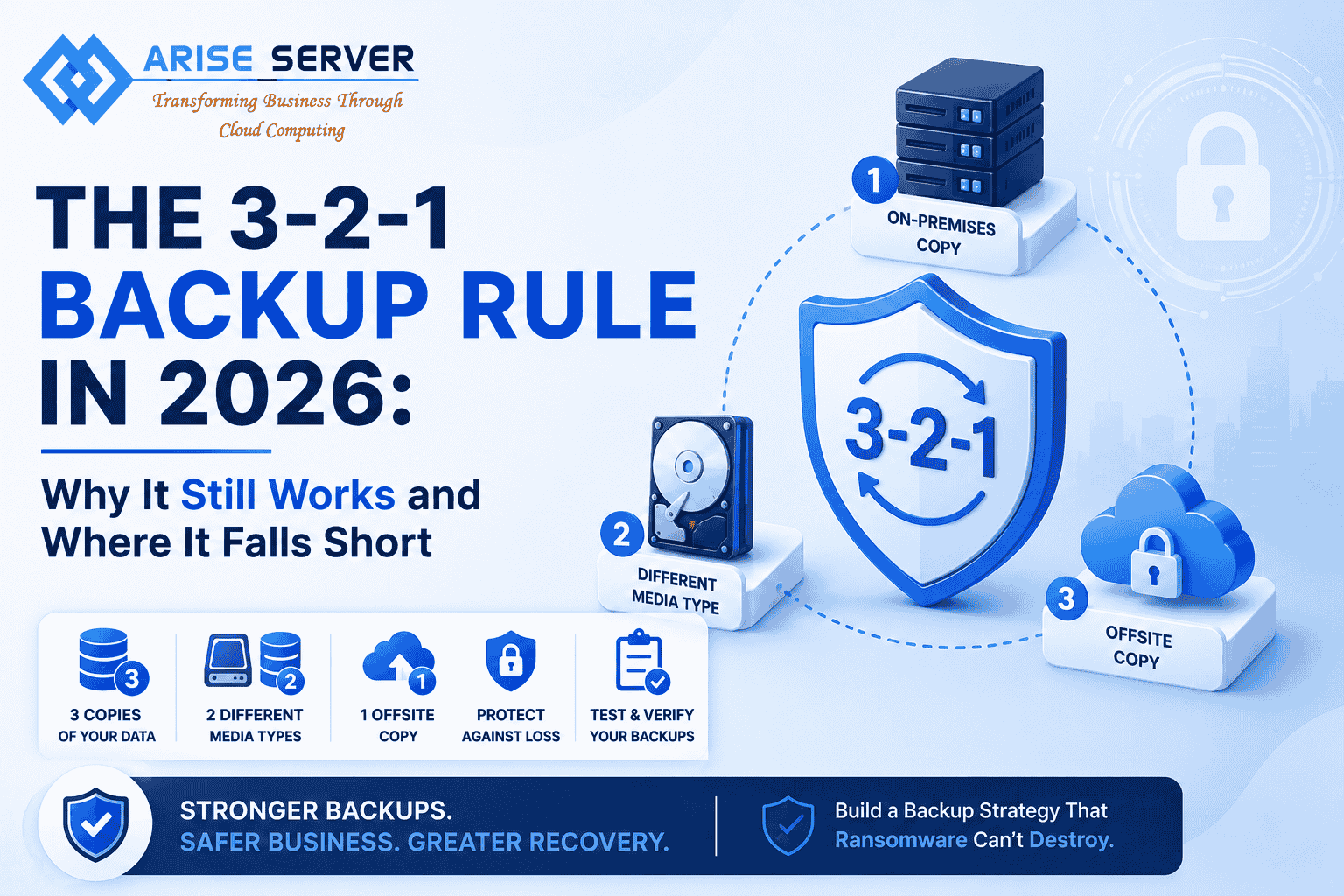
The 3-2-1 Backup Rule in 2026: Why It Still Works and Where It Falls Short
Backing up your data is never just about protecting against a failed hard drive or an employee accidentally deleting a file. In fact, there are many businesses that are still based on a single backup copy. These are often stored on the same network, server, or cloud account as their production data.
That’s why the 3-2-1 backup rule remains an important starting point for businesses’ data protection. Be it healthcare, finance, e-commerce, software, education, professional services, manufacturing, or almost every other data-dependent industry, it follows the 3-2-1 backup rule. From a failed disk, accidental deletion, database corruption, hardware failure, cloud outage, insider mistake, or ransomware infection to a compromised administrator account, a healthy backup often leads to a recovery solution.
Whereas the original 3-2-1 model remains valuable because its main idea is not to let one failure take away every copy of your data. But modern businesses need to consider if their backup can be altered, whether attackers can reach it, and how the business can actually restore critical systems within its required timeline.
Because of this, businesses have shifted towards concepts like immutable backups, air-gapped storage, isolated recovery environments, least-privilege access, recover-point objectives (RPO), and recovery-time objectives (RTO). This means that the 3-2-1 backup rule has become obsolete for businesses. Especially when backup stands as a security and recoverability problem and not just a storage problem.
This blog aims to understand the 3-2-1 backup rule from a recovery-first perspective, where the traditional model still works, and examine the 3-2-1-1-0 backup rule and show how to build a practical business backup strategy without turning backup management into a complicated project.
Why does the 3-2-1 backup rule remain the gold standard?
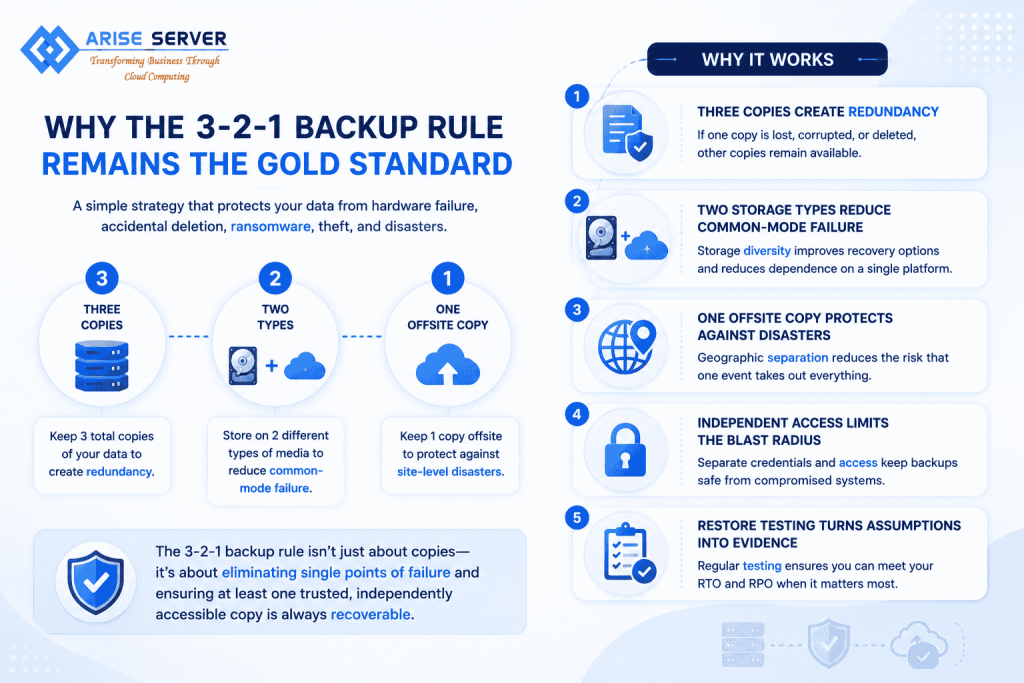
Before we move on to understanding that, it is essential to know what the 3-2-1 backup rule is exactly. By definition, it is a famously used strategy for protecting your data against hardware failure, accidental deletion, ransomware, theft, or disasters. Be it changes in storage technology, cloud adoption, virtualization, SaaS, or increasingly sophisticated cyberattacks, the 3-2-1 backup rule has survived it all.
Moreover, what makes this rule more durable is the separation that it forces you to build into your own backup strategy:
⦁ Three copies create redundancy
If every copy depends on the same storage technology, and if it gets corrupted or accidentally deleted, another copy remains available.
⦁ Two storage types reduce common-mode failure
Having storage diversity improves recovery options, where combining disk-based storage with cloud or offline storage reduces dependence on a single platform
⦁ One offsite copy protects against site-level disasters
Geographic separation reduces the correlation risk, as a major facility outage should not be capable of destroying production and every backup simultaneously.
⦁ Independent access limits blast radius
Having separate credentials strengthens backup security so if attackers compromise production systems, they should not be able to modify or delete every recovery copy.
⦁ Restore testing turns assumptions into evidence
Organizations should periodically test whether they can meet their recovery time and recovery point objectives (RTO/RPO).
Having said that, the 3-2-1 backup rule is not just about having three copies of data; rather, the aim is to eliminate common points of failure and make sure that at least one trustworthy, independently accessible copy remains recoverable.
VPS Server Plans
An ideal VPS solution for modern projects combines strong security, high-speed performance, and flexible, scalable configurations to match your evolving requirements.
The hidden risks of a single backup
While one backup is better than none, it can still fail for the same reason your original data fails. But the point is that your backup can survive the same incident that takes down your primary data. Because a single backup can leave a business exposed to several forms of shared failure.
Here’s the biggest hidden risk of a single backup:
- Location risk
- Access risk
- Infrastructure risk
- Integrity risk
- Recovery risk
Additionally, modern backup architecture increasingly overlaps with cybersecurity. This is ultimately why the 3-2-1 rule remains so useful, as it creates enough separation that the organization retains a recovery path.
Share Your Custum Server Requirements
How did ransomware change the backup equation?
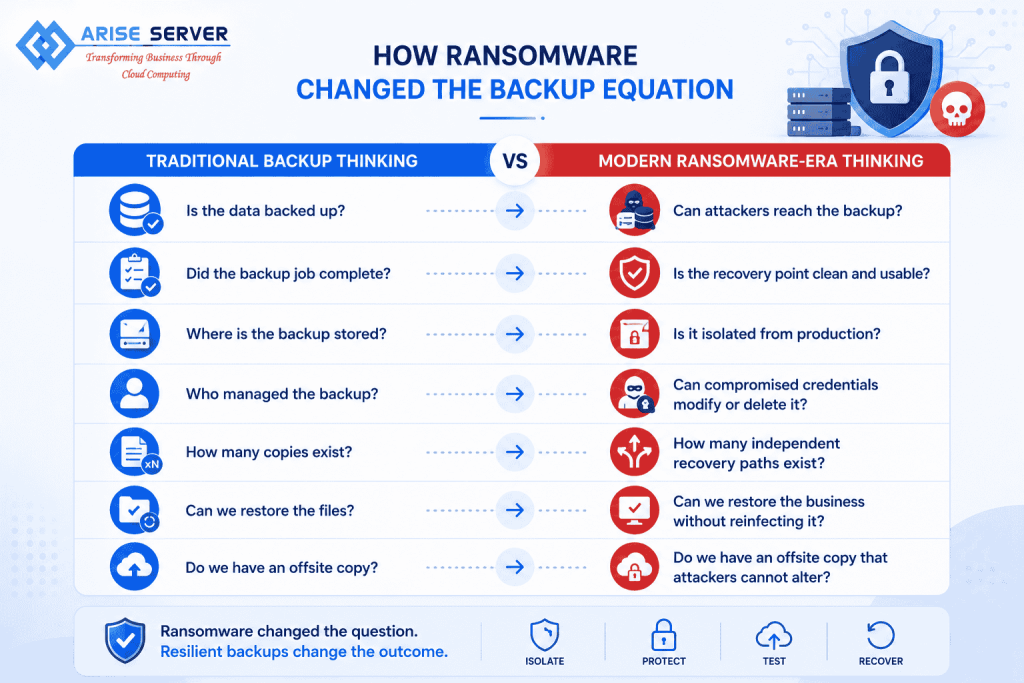
Primarily, the backup used to be the way out of a ransomware attack; however, now it can be one of the first things attackers try to destroy. Here’s the difference between traditional backup thinking and modern ransomware-era thinking:
| Traditional backup thinking | Modern ransomware-era thinking |
| Is the data backed up? | Can attackers reach the backup? |
| Did the backup job complete? | Is the recovery point clean and usable? |
| Where is the backup stored? | Is it isolated from production? |
| Who managed the backup? | Can compromised credentials modify or delete it? |
| How many copies exist? | How many independent recovery paths exist? |
| Can we restore the files? | Can we restore the business without reinfecting it? |
| Do we have an offsite copy? | Do we have an offsite copy that attackers cannot alter? |
Dedicated Server Plans
The ideal solution for large-scale projects delivers strong security, top-level performance, and customizable configurations.
Conclusion
In conclusion, the 3-2-1 backup rule still makes sense in 2026 because its central principle is that one failure should not be able to eliminate every path back to your data.
Hence, the goal is not to have the most backups. It is to have a trustworthy recovery path when your primary environment is unavailable, compromised, or no longer reliable.
Need a more resilient backup setup? Speak with the Arise Servers team about your backup, storage, and recovery requirements.

FAQ’s
Visit Our Other Server Locations
Explore our global dedicated server locations with high performance, strong security, and scalable configurations tailored for your business needs.