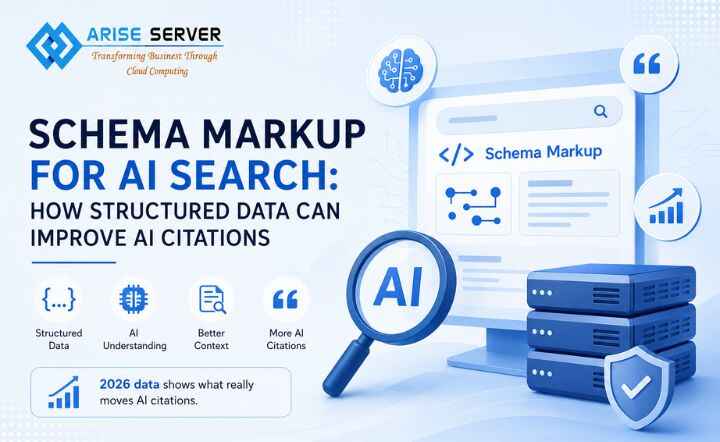
Schema Markup for AI Search: How Structured Data Can Improve AI Citations
SEO has always had a weakness for technical shortcuts, so if you have been told that schema markup gets your website cited by AI, it is time to look more closely at the evidence. Especially when schema markup is presented as the technical shortcut to visibility in ChatGPT, Google AI overviews, Google AI Mode, and other AI search experiences.
While the logic is simple, that makes your content easier for machines to understand, and AI systems should be more likely to select and cite it. Which raises a bigger question of whether schema is not the shortcut and what makes a website a source that AI systems can reliably understand, retrieve, and trust? Be it topic depth, credible authorship, third-party authority, crawlability, page accessibility, and the technical reliability of the environment delivering that information. A company website today might need to serve traditional search engines, AI answer engines, customers, APIs, applications, employees, and increasingly automated workflows. Which means the stronger objective is a dependable digital foundation where useful information is easy to access, technically available, clearly presented, and supported by infrastructure capable of handling changing demands.
Having said that, for businesses building their digital presence for the long term, visibility is not simply about adding another layer of code; rather, it is about creating an infrastructure and content foundation that can support changing search systems, growing traffic, and increasingly demanding applications.
How does schema markup help AI citations understand your content?
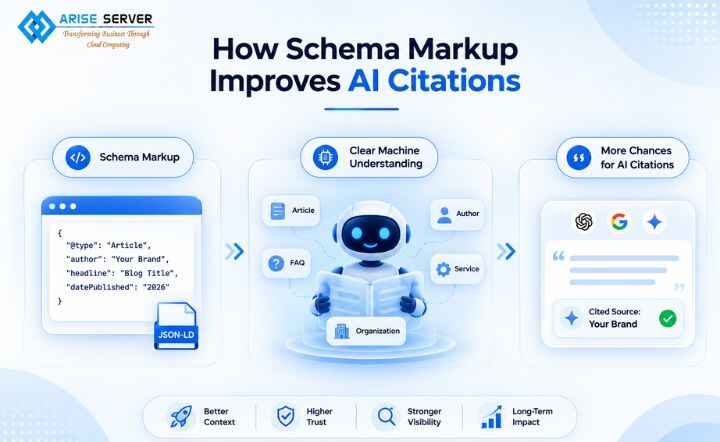
AI search has turned a basic website question into a more technical one: whether machines understand what your content actually represents. Schema markup is structured data added to a webpage to help search engines and other machine systems understand what the page and its information represent. It can identify organizations, people, articles, products, services, FAQs, or locations using a standardized vocabulary, commonly implemented with JSON-LD.
And for AI citations, it provides a standard way to describe what information on a webpage represents, instead of leaving it to machine interpretation.
Here’s what schema can tell search systems:
| Without structured context | With schema markup |
| This page contains text about a company | This is an organisation |
| This person appears to be an author | This person is the author |
| This page appears to describe a service | This is a service |
| These questions appear on the page | These are FAQ-style questions and answers |
| Several entities are mentioned | Relationships between entities can be defined |
For businesses, the goal should not be to just make pages machine-readable; rather, it should be to build a digital environment where information is clearly presented, consistently accessible, technically reliable, and easy for both people and machines to retrieve.
VPS Server Plans
An ideal VPS solution for modern projects combines strong security, high-speed performance, and flexible, scalable configurations to match your evolving requirements.
Does adding schema markup increase AI citations?
Based on the strongest controlled evidence available, not reliably. While schema markup AI citations can help search engines interpret the meaning and structure of webpage content, adding it alone has not been shown to produce a meaningful increase in AI-generated citations.
Whereas the assumption is that schema markup gives search engines structured information about a webpage, a large 2026 Ahrefs experiment tested that assumption directly and found that adding schema did not produce any meaningful citation increase.
Additionally, here’s what the study found further:
| AI platform | Citation change after schema | Result |
| Google AI overviews | -4.6% | Small decline relative to controls |
| Google AI mode | +2.4% | Not statistically significant |
| ChatGPT | +2.2% | Not statistically significant |
The point is that the study did not find any clear positive effect, so the practical takeaway should be that as a business you can use schema, as it provides useful structured context and supports search engine understanding. Especially for AI visibility, schema should sit alongside strong visible content, technical accessibility, authority, and a reliable website foundation.
hare Your Custum Server Requirements
The four signals that make your content citation-worthy
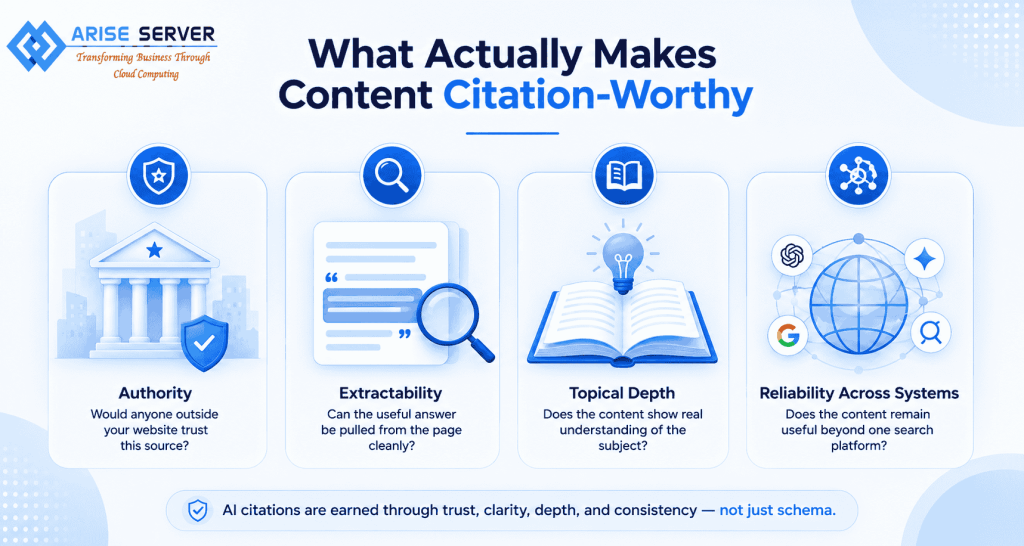
What makes an AI system decide that your page is worth citing is one of the most important questions that you should explore as a business. While there’s no universal checklist published by ChatGPT, Google AI mode, Perplexity, or other AI search platforms, there does exist a credible, easy-to-extract, deeply supported, and consistently useful set of signals across retrieval environments.
Read Also: What Is Bandwidth Throttling and How Does It Happen?
Here are four practical signs that make your content citation-worthy:
- Authority: Would anyone outside your own website trust this source?
- Extractability: Can the useful answer be pulled from the page cleanly?
- Topical depth: Does the website understand the subject or just the keyword?
- Reliability across systems: Does the content remain useful beyond one search platform?
Apart from that, a page cannot be retrieved if it cannot be reliably delivered. Content quality matters, but so do crawlability, availability, security, performance, and the infrastructure supporting the website
Dedicated Server Plans
The ideal solution for large-scale projects delivers strong security, top-level performance, and customizable configurations.
Conclusion
In conclusion, schema markup for AI citations helps search systems understand what your content represents, but it is not a shortcut to AI citations.
Hence, the future of search is not just about optimizing pages. It is about building digital experiences that search engines, AI systems, and people can consistently access and trust.

FAQ’s
Visit Our Other VPS Server Locations
Explore our global VPS server locations with high performance, full root access, enterprise-grade security, and scalable hosting solutions for your business.