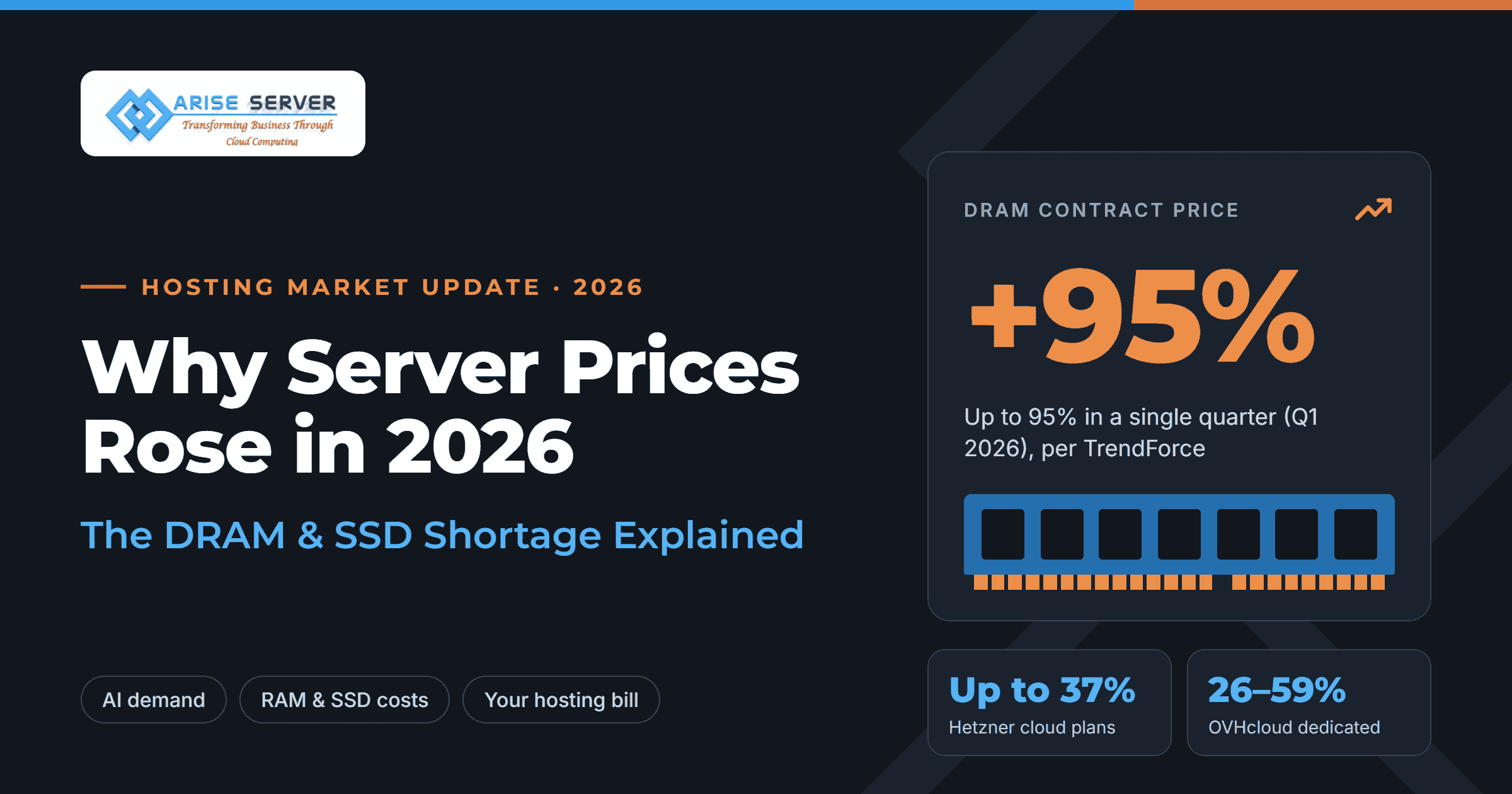
Why Server Prices Rose in 2026: The DRAM and SSD Shortage Explained
If your hosting renewal arrived this year with a higher number on it, you’re not alone. In 2026, server and cloud prices went up across the industry, and in some cases by a lot.
Hetzner raised prices on cloud servers, dedicated hardware and object storage from 1 April 2026, by up to 37% on some cloud plans. OVHcloud announced increases on selected dedicated servers from 1 October, ranging from 26% to 59% depending on the hardware generation, and up to 87% on its newest game server range. Dell, HPE and Lenovo all raised server list prices in the first quarter of the year.
The cause is the same everywhere: memory. RAM and SSDs, the parts inside every server, became much more expensive and harder to get. This article explains why that happened, how it reaches your monthly bill, and what you can realistically do about it.
What actually happened to memory prices
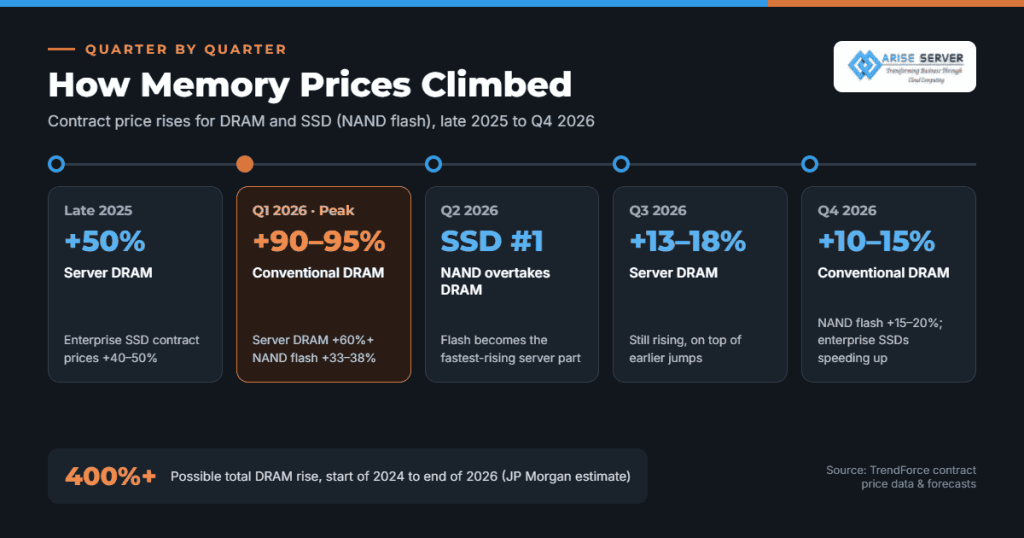
Memory prices move in cycles, but 2026 was unusual even by those standards. TrendForce, the market research firm most hosting and hardware companies follow, tracked contract prices quarter by quarter:
| Period | What happened |
| Late 2025 | Server DRAM prices rose roughly 50%; enterprise SSD contract prices rose 40–50% |
| Q1 2026 | Conventional DRAM contract prices forecast up 55–60%, later revised to 90–95%; server DRAM up more than 60% |
| Q1 2026 | NAND flash (SSD) prices forecast up 33–38%; client SSDs up 40% or more |
| Q2 2026 | NAND flash overtook DRAM as the fastest-rising component |
| Q3 2026 | Server DRAM contract prices forecast up another 13–18% |
| Q4 2026 | Conventional DRAM forecast up 10–15%; NAND flash up 15–20%; enterprise SSDs the only category speeding up |
Those are quarter-on-quarter rises stacked on top of each other. JP Morgan estimated that DRAM prices could rise more than 400% between the start of 2024 and the end of 2026. Some server-grade modules on the spot market jumped by more than that.
The pace is slowing in late 2026. But slowing isn’t the same as falling. Prices are still going up every quarter, just by less.
Why it happened: AI ate the memory supply
There are only three big DRAM makers: Samsung, SK hynix and Micron. Each has a limited number of factories, and each factory can only make so many chips. When demand rises sharply, they can’t just build new capacity overnight. A new memory fab takes years.
So what changed? AI servers.
Training and running large AI models needs a special kind of memory called HBM (high bandwidth memory), stacked right next to the GPU. HBM is far more profitable than ordinary RAM, and it uses a lot of the same factory capacity. SK hynix reportedly sold out its entire 2026 HBM production well in advance.
When manufacturers shift production lines towards HBM and high-end server DDR5, less capacity is left for the standard memory used everywhere else, including the RDIMMs inside ordinary web, database and VPS servers. At the same time, the big US cloud providers are locked in huge long-term supply deals. That left smaller buyers, including regional hosting companies, competing for what was left on the open market at much higher prices.
SSDs followed the same pattern. AI inference systems need large, fast storage to hold model data and caches. TrendForce expects enterprise SSD demand to grow by more than 80% in 2026, with most new supply already committed to cloud providers.
None of this is a short-term blip caused by one bad quarter. It’s a structural shift in who memory gets made for.
Dedicated Server Plans
Arise Dedicated Servers deliver powerful performance, reliable infrastructure, and flexible resources for businesses, high-traffic websites, applications, and demanding workloads.
Why your hosting bill follows
It’s easy to think of hosting as a service, not hardware. But every VPS, cloud instance and dedicated server runs on physical machines full of DRAM and flash. When those parts cost more, the provider’s cost to build or refresh a server goes up.
A few things make the impact bigger than you might expect:
Memory is a big share of server cost. On a modern server with a lot of RAM, memory can be one of the most expensive parts. Doubling its price moves the total a lot.
Refresh cycles can’t wait forever. Hosts replace old hardware every few years. Servers bought in 2026 cost noticeably more than the ones they replace. One industry example: a budget planned to replace 25 servers bought less hardware than expected, with longer delivery times too.
Smaller providers pay more. Large clouds sign long-term contracts. Smaller hosts buy closer to the spot market, where prices swing the most.
Other costs rose at the same time. Electricity prices climbed sharply in several US states. VMware licensing costs jumped for teams that rely on it. Even the wholesale price of .com domains goes up 7% on 1 November 2026.
This is why providers that rarely change prices did so in 2026. Hetzner, which usually aims for prices that stay stable for years, didn’t exempt even existing customers on long-term contracts this time.
What got more expensive, and what didn’t
The increases aren’t spread evenly. Based on what providers announced this year, the pattern looks like this:
- High-memory servers rose the most. Plans with 128 GB, 256 GB or more RAM saw the biggest increases, because RAM is the most expensive part.
- New hardware rose more than older generations. OVHcloud’s increases were steepest on its newest 2026 servers. Older generations, already paid for, moved less.
- NVMe storage got pricier. Large NVMe configurations cost more to build, especially in the second half of the year.
- CPU-only, low-RAM servers moved less. If your workload doesn’t need much memory, your costs probably rose less.
For anyone choosing hardware, this is useful. The cheapest way to save money in 2026 is often to buy less RAM, not a smaller CPU.
Will prices come down?
Probably not soon. TrendForce has said PC DRAM supply could tighten further in 2027 as more capacity moves to servers, and analysts describe the DRAM market as structurally tight into next year. New factories are being built, but they take years to come online.
The realistic expectation for 2027 is stable to slightly higher prices, not a return to 2024 levels. Hosting price rises that happened this year are unlikely to be reversed.
What you can do about it
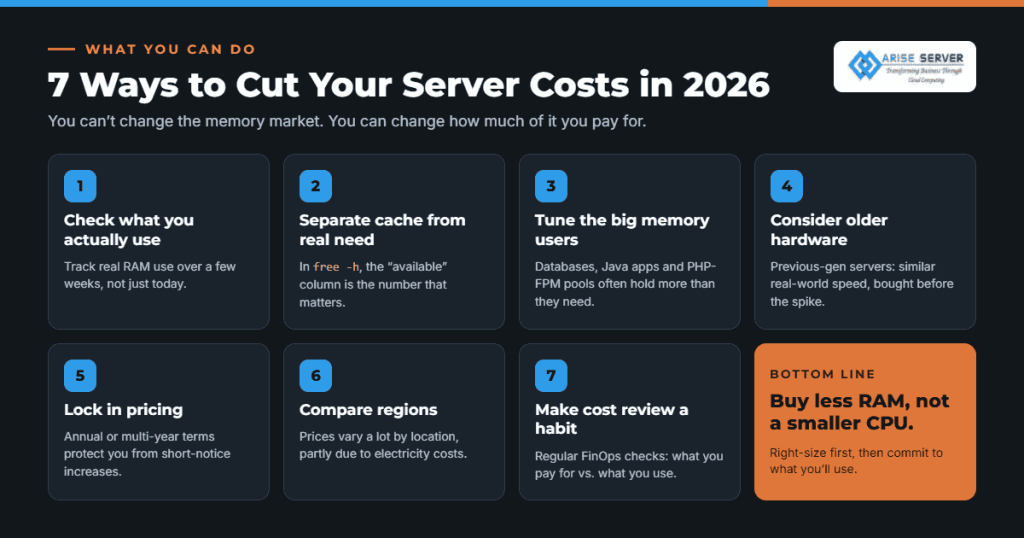
You can’t change the memory market. You can change how much of it you pay for.
1. Check what you actually use. Many servers are bought with far more RAM than they need, “just in case”. Look at real memory use over a few weeks, not just today. Our companion guide on how to right-size RAM on a server walks through the exact commands and what the numbers mean. (Link to Blog 2 once published.)
2. Separate cache from real need. Linux uses spare RAM as file cache, so a server that looks “90% full” often isn’t. The available column in free -h is the number that matters.
3. Tune the big memory users. Databases, Java apps and PHP-FPM pools often hold more memory than they need because of default or old settings. Tuning innodb_buffer_pool_size or pm.max_children can free gigabytes without touching performance.
4. Consider older hardware. Previous-generation servers often give you the same real-world performance for typical websites and apps at a lower price, because their parts were bought before the spike. Arise’s clearance servers are one example of this.
5. Lock in pricing where you can. If a plan works for you, ask about longer terms. Some providers still offer price guarantees on annual or multi-year commitments. Monthly billing gives the provider room to change prices at short notice.
6. Compare regions. Prices differ a lot by location, partly because of electricity costs. Our VPS price comparison across India, Germany and the USA shows how big the gap can be.
7. Make cost review a habit. This is exactly the kind of situation FinOps for hosting is meant for: regular checks on what you’re paying for versus what you use.
VPS Server Plans
An ideal VPS solution for modern projects combines strong security, high-speed performance, and flexible, scalable configurations to match your evolving requirements.
Should you buy now or wait?
If you know you’ll need more capacity in the next six to twelve months, buying or committing sooner is usually better than waiting. The direction of prices for 2026 and into 2027 is up, not down, and delivery times for new hardware have lengthened.
If you’re not sure you need the capacity, don’t buy it out of fear. Right-size first. Then commit to what you know you’ll use.
When comparing options, look at the whole picture. A dedicated server with a fixed monthly price can be cheaper over a year than cloud instances that bill for every gigabyte of RAM and storage. For smaller workloads, a well-sized VPS may be enough. If you run your own hardware, colocation pricing is driven mostly by power and space, not memory, but the servers you put in the rack still cost more to buy. And if you’re choosing between storage types, our post on why NVMe is faster than SSD helps you decide where the extra cost is worth it.

The short version
Server prices rose in 2026 because memory makers shifted production towards AI, big cloud providers locked up supply, and everyone else paid more for what was left. DRAM and SSDs became the most expensive parts of a server, and hosting prices followed.
Prices are still rising in Q4 2026, more slowly than before, and are unlikely to fall much in 2027. The best response is not panic buying. It’s paying only for the memory and storage you actually use, and locking in good pricing where you can.
FAQ’s
Visit Our Other VPS Server Locations
Explore our global VPS server locations with high performance, full root access, enterprise-grade security, and scalable hosting solutions for your business.