Why Power Is Now the Biggest Bottleneck for Data Centers
Ask someone what limits a data centre and they’ll usually say space: floor area, racks, buildings. In 2026, that answer is out of date. The real limit is electricity.
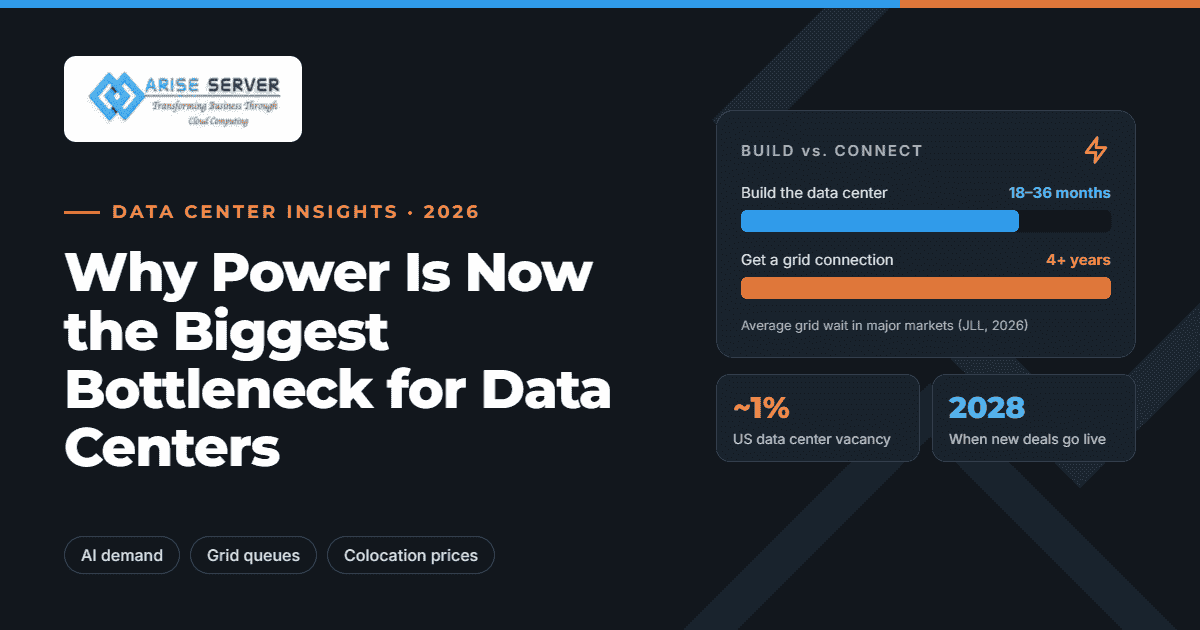
JLL’s 2026 global data centre outlook calls power the primary factor in choosing where to build. In the busiest markets, the average wait to get a new grid connection is now more than four years. In North America, JLL’s midyear 2026 report describes capacity pushed to its limit by AI demand and multi-year grid queues. Vacancy in the US sits close to 1%, and companies signing deals today are often looking at space that won’t be ready until 2028.
This matters well beyond hyperscalers. It affects colocation prices, how fast hosting providers can add capacity, where new data centres appear, and what your own servers cost to run. Here’s how we got here and what it means in practice.
How much power are we talking about?
The numbers have grown fast.
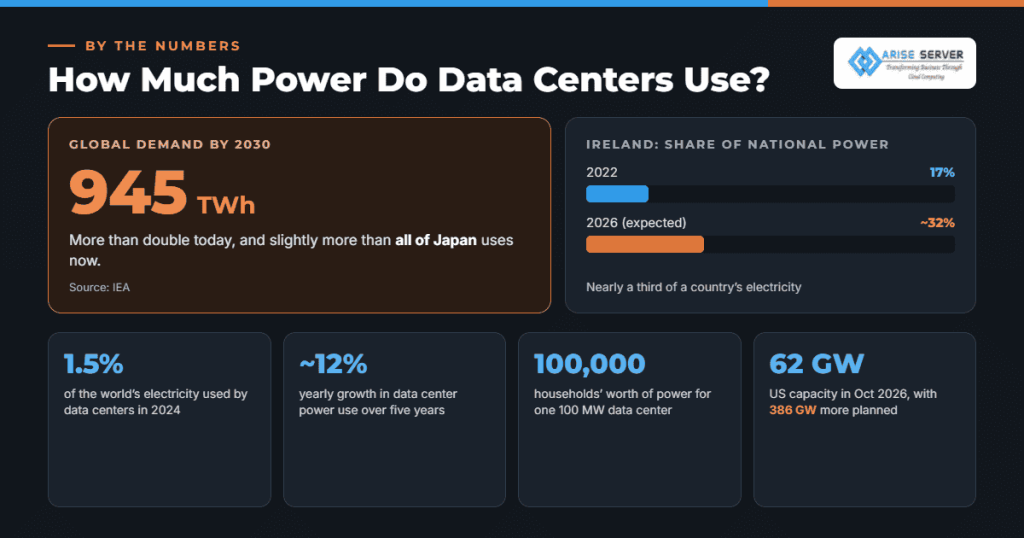
The International Energy Agency (IEA) estimates that data centres used about 1.5% of the world’s electricity in 2024, and that their use grew around 12% a year over the previous five years. It expects data centre electricity consumption to more than double by 2030, to about 945 TWh, which is slightly more than Japan uses today.
Scale makes this concrete. The IEA notes that a single 100 MW data centre can use as much electricity as 100,000 households. Some facilities now under construction will draw as much as two million households.
In the United States, total data centre capacity passed 62 GW in October 2026, according to Cleanview data, with another 386 GW in planning. McKinsey expects demand to nearly triple by 2030.
Some countries already feel it directly. In Ireland, data centres used 17% of national electricity in 2022, and the IEA expected that share to reach around 32% in 2026.
Dedicated Server Plans
Arise Dedicated Servers deliver powerful performance, reliable infrastructure, and flexible resources for businesses, high-traffic websites, applications, and demanding workloads.
Why AI changed the maths
Traditional servers are fairly modest. A rack of web or database servers might draw a few kilowatts. A rack of modern AI servers packed with GPUs can draw tens of kilowatts or more. Put thousands of those racks in one building and the power requirement jumps from “large office block” to “small town”.
Two other things make it harder:
- AI demand arrived quickly. Grids are planned over decades. Data centre demand jumped in two or three years.
- It’s concentrated. Data centres cluster in a few hubs for connectivity reasons, so the strain lands on specific local grids rather than spreading out.
And the build-out keeps going. In 2026, the conversation has shifted from training to inference, which means AI is now a constant, 24/7 load, not just big one-off training runs.
Why grids can’t keep up
Building a data centre takes 18 to 36 months. Getting a large new grid connection can take much longer. Utilities need to study the request, upgrade substations, sometimes build new transmission lines, and get permits for all of it. In primary markets, that queue now averages more than four years.
There’s also pushback. JLL notes growing local opposition to new builds, driven by concerns over electricity prices, water use, noise and land. Some regions have paused or tightened approvals.
The result is a strange situation: plenty of money, land and demand, but no way to switch the building on.
Read Also: CXL Memory Expansion Explained: Adding RAM Beyond DIMM Slots
What the industry is doing about it
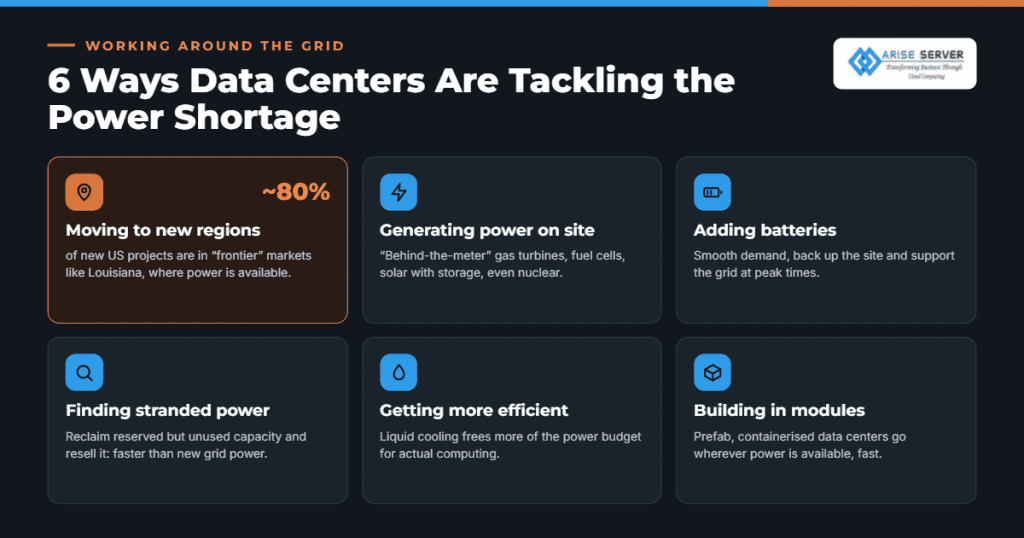
Operators are responding in several ways, and each one affects the market.
1. Moving to new regions. When the established hubs are full, developers go where power is available. Around 80% of new US data centre projects are now in “frontier” markets that had almost no data centres before 2025, such as Louisiana. Regional hubs with spare grid capacity are winning projects.
2. Generating power on site. “Behind-the-meter” power means building generation next to the data centre instead of waiting for the grid: gas turbines, fuel cells, solar with storage, and in some announced projects, nuclear. JLL expects more of this in 2026. Renewables and microgrids are being used for energy independence and resilience.
3. Adding batteries. Large battery systems help smooth demand, back up the site and sometimes support the grid at peak times. Newer UPS designs are being built to do double duty for backup and active power management.
4. Finding stranded power. Many existing data centres have capacity reserved for customers who never fully use it. Operators are learning to measure and reclaim this “stranded” power and resell it, which is faster than waiting for new grid capacity.
5. Getting more efficient. Liquid cooling is becoming standard for high-density racks because it moves heat much more efficiently than air. That frees more of the site’s power budget for computing. We explored this in why liquid cooling is becoming important for AI servers.
6. Building in modules. Prefabricated and containerised data centres can go wherever power is available, quickly. Grid delays and permitting backlogs are a major reason this market is growing.
What this means for hosting and colocation customers
You probably don’t negotiate with utilities. But the power shortage still reaches you.
Colocation is priced by power, not space. A colocation bill is driven mostly by the kilowatts your rack is allowed to draw. As power gets scarce, the price per kW goes up, and high-density racks become expensive or hard to get. Our breakdown of what colocation pricing is actually made of explains how power, space and bandwidth add up. You can also see current options on our colocation pricing page.
Electricity costs rise. In 2026, some US states saw electricity price rises of more than 50%: Maine about 95%, California about 64%, Connecticut about 59% and New Jersey about 55%, according to one provider’s analysis. Data centres without hedged energy contracts pass those increases straight to customers.
Capacity takes longer. When a provider can’t get new power, it can’t add new racks or servers quickly. That shows up as longer lead times for large deployments and fewer “available today” options in popular locations.
Location choices shift. The most popular hubs aren’t always the best choice now. A slightly less central location with available power may give you better pricing and room to grow. Our guide on choosing the best data centre location for your server covers how to balance latency, cost and availability.
VPS Server Plans
An ideal VPS solution for modern projects combines strong security, high-speed performance, and flexible, scalable configurations to match your evolving requirements.
What you can do
Measure what your servers draw. Many racks are provisioned for far more power than they use. If you’re paying for 5 kW and drawing 2.5, there’s room to consolidate or renegotiate. Most server management interfaces (iDRAC, iLO, IPMI) show real power use.
Retire inefficient hardware. Older servers often use much more electricity for the same work. When power is priced at a premium, the savings from replacing a few ageing machines with one newer one can be real, even with high hardware prices.
Consolidate. Virtualisation and containers let you run more on fewer machines. Fewer servers means fewer watts.
Plan capacity early. If you’ll need more racks or high-density space in the next year or two, talk to your provider now. Waiting until you need it may mean waiting a long time.
Spread your footprint. Running in more than one region protects you from a single location running out of room, as well as from outages. Our guide on when to go multi-region helps you decide when it’s worth it.
Consider the edge. Not every workload needs to sit in a power-hungry central hub. Smaller sites closer to users can carry some of the load, especially for inference. See edge AI hosting and why it matters.
Understand what you’re buying. If colocation is new to you, start with what colocation hosting is and why companies move servers into professional data centres.

Will this ease soon?
Not quickly. New transmission lines and power plants take years. Behind-the-meter generation, batteries and efficiency gains help at the margins, and new regions will add capacity. But demand from AI keeps growing too.
The realistic expectation for the next few years is that power stays the main limit on data centre growth, colocation pricing stays firm, and the providers who secured power early will have the most room to offer customers.
FAQ’s
Visit Our Other Server Locations
Explore our global dedicated server locations with high performance, strong security, and scalable configurations tailored for your business needs.