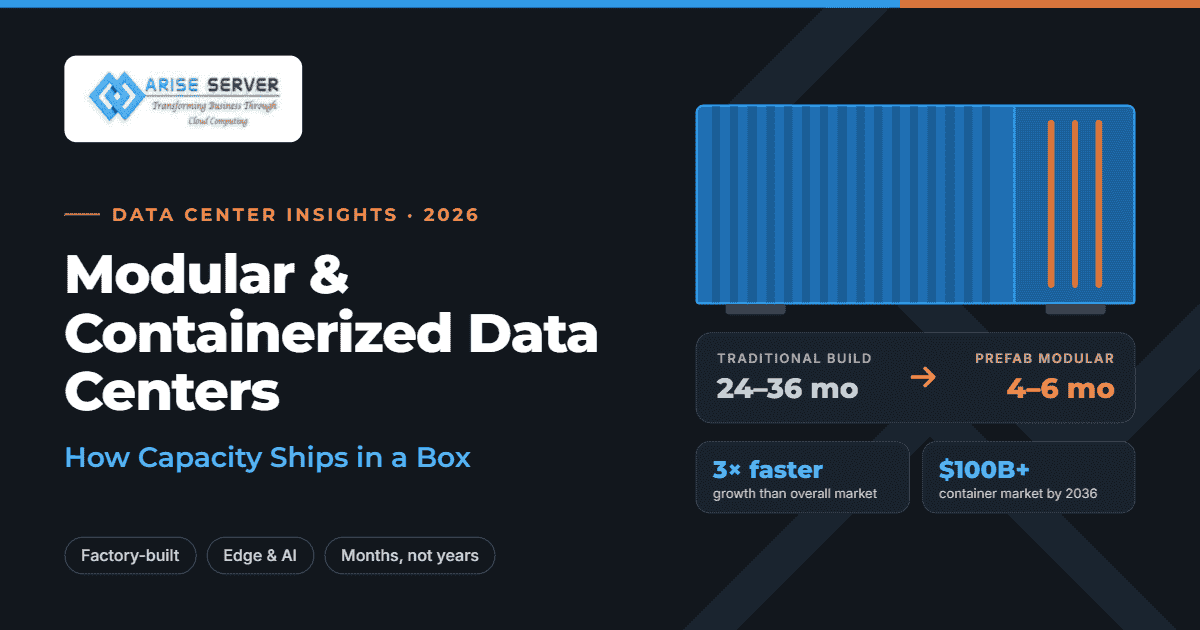
Building a traditional data centre is slow. From design to powering on the first rack typically takes two to three years. Concrete has to be cured, electricians and mechanical contractors work in sequence on site, and every building ends up slightly different from the last.
In 2026, that pace doesn’t match demand. AI workloads need capacity now, grid connections are scarce, and companies want computing in places that never had a data centre before. So more of the industry is building data centres the way cars are built: in a factory, then shipped.
Modular data centres are growing about three times faster than the overall data centre market, according to research firm Omdia. The containerised segment alone is projected to grow from about $19 billion in 2026 to more than $100 billion by 2036. Here’s what these facilities are, how they work, and where they make sense.
Three kinds of “data centre in a box”
The terms get mixed up, so it helps to separate them.
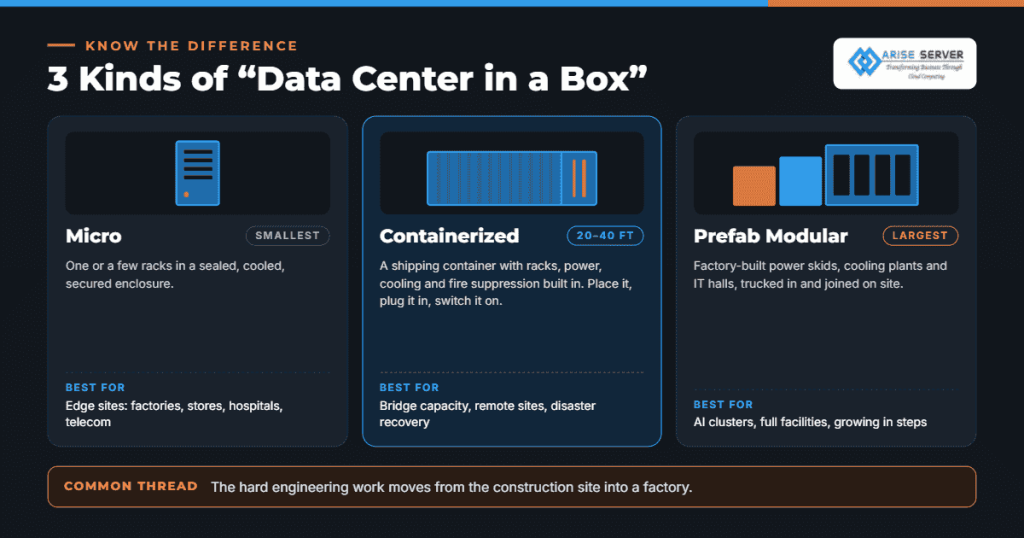
Containerised data centres are built inside shipping containers, usually 20- or 40-foot units, with the 40-foot size the most common. Each one is a self-contained room with racks, power distribution, cooling and fire suppression. You put it on a prepared pad, connect power, network and sometimes water, and switch it on.
Prefabricated modular data centres are bigger and more flexible. Instead of one sealed box, the major systems are built as factory modules: power skids with switchgear and UPS, cooling plants, and sometimes entire IT halls. These modules arrive on trucks and are joined together on site to form a full facility. Some modules sit inside a conventional building shell. Others form the building themselves.
Micro data centres are the smallest version: one or a few racks in a sealed, cooled, secured enclosure. They’re built for edge locations like factories, stores, hospitals and telecom sites where a full facility would be overkill.
The common thread is that the hard engineering work moves from the construction site into a factory.
Why factory-built is faster
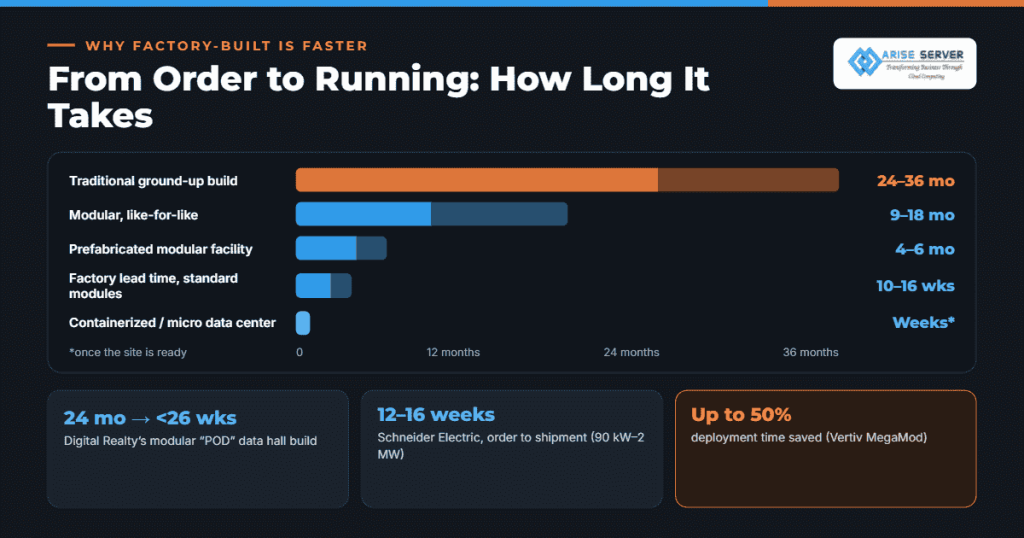
A conventional build runs in sequence: design, civil works, building shell, then electrical and mechanical fit-out, then integration and testing. Each stage waits for the one before.
Modular construction runs these in parallel. While the site is being prepared, the power and cooling modules are being built and tested in a factory. When the ground is ready, the modules arrive finished.
The timelines published by vendors and builders show the difference:
| Approach | Typical time |
| Traditional ground-up build | 24–36 months |
| Modular, like-for-like with a traditional build | 9–18 months |
| Prefabricated modular facility | 4–6 months (6–12 for larger sites) |
| Factory lead time, standard modules | 10–16 weeks from design lock |
| Containerised or micro data centre | Weeks once the site is ready |
Some specific examples: Schneider Electric quotes 12 to 16 weeks from purchase order to shipment for prefabricated configurations from 90 kW to 2 MW. Digital Realty said its modular “POD” approach cut a data hall’s construction time from about 24 months to under 26 weeks. ABB and Vertiv both cite deployment time savings of up to 30%, and Vertiv claims up to 50% for its liquid-cooled MegaMod range.
Design is quicker too. Because modules come from a known catalogue, one manufacturer reports that design freeze can shrink from about 12 weeks to six to eight.
VPS Server Plans
An ideal VPS solution for modern projects combines strong security, high-speed performance, and flexible, scalable configurations to match your evolving requirements.
Why modular is booming in 2026
Power is the bottleneck. In major markets, getting a new grid connection takes more than four years. When power becomes available, or when a site can generate its own, operators want to use it immediately. Modular units let them put capacity exactly where the power is, as soon as it’s there. Market analysts specifically name grid delays and permitting backlogs as drivers of containerised deployments. (Link to Blog 4 once published.)
AI needs high density and liquid cooling. AI racks run far hotter than traditional servers. Retrofitting old buildings for liquid cooling is hard. Factory-built modules can be designed for it from the start, with coolant distribution and direct-to-chip cooling built in. CoreSite expects skid-mounted modular units starting at 2 MW to become the standard model for high-density builds by late 2026. Our article on why liquid cooling is becoming important for AI servers explains why.
Edge computing. Some workloads need to run near users or machines: AI inference for video analytics, factory automation, telecom functions, retail systems. Shipping a small modular unit to a site is much easier than building a data centre there. We covered this in edge AI hosting: what it is and why it matters.
Data must stay in-country. Data localisation rules and sovereign cloud requirements are pushing companies to run infrastructure inside specific borders. Portable modular units are one way to add local capacity quickly in markets without enough existing data centres. If you’re working through those rules, see data sovereignty vs data residency.
Predictable cost. Factory assembly means fewer surprises. Costs are known up front, and there’s less rework on site. Some vendor analyses claim big savings. One example compares a 5 MW deployment at roughly $55 million built traditionally versus $40 million modular. Treat vendor figures with care, but the direction is consistent: less time on site usually means less cost.
Where modular data centres are used
- Bridge capacity. Adding space quickly while a permanent building is under construction.
- AI clusters. Dropping liquid-cooled GPU capacity next to available power.
- Edge sites. Telecom towers, factories, hospitals, retail chains, smart city systems.
- Remote and harsh locations. Mining, energy, research stations, military and disaster recovery, where building a conventional facility isn’t practical.
- Expansion in steps. Adding capacity one module at a time as demand grows, instead of building a huge hall that sits half empty for years.
That last point is underrated. A traditional data centre is often built for the size it will need in ten years. With modular, you pay for what you need now and add more later.
Dedicated Server Plans
Arise Dedicated Servers deliver powerful performance, reliable infrastructure, and flexible resources for businesses, high-traffic websites, applications, and demanding workloads.
The real limits
Modular isn’t magic. A few things don’t change just because the building came on a truck.
It still needs power. A container can be installed in weeks, but if there’s no grid connection or on-site generation, it can’t run. Modular speeds up the building part, not the utility part.
Permits and site work still apply. Foundations, utility connections, fire codes and local approvals still take time. Analysts note that when site preparation, utilities and permitting are equal for both approaches, the speed advantage of modular narrows considerably.
Less flexibility. Standard modules are fast because they’re standard. Heavy customisation brings back the delays. Each design revision after approval can add two to four weeks of factory time.
Physical constraints. Containers have limited space for maintenance access, and very high-density equipment can push their cooling and weight limits. Large AI systems often need prefabricated halls rather than shipping containers.
Supply chain. Modules depend on the same switchgear, transformers, UPS systems and chillers as any data centre. When those are scarce, lead times stretch for everyone.
Security and resilience. A container in a car park needs the same physical security, redundancy and monitoring as a room in a big facility. Check the tier rating and redundancy design, not just the delivery date.
Read Also: Why Power Is Now the Biggest Bottleneck for Data Centers
Modular vs traditional: a quick comparison
| Factor | Traditional build | Modular / prefabricated |
| Time to first rack | 2–3 years | Weeks to months |
| Upfront cost | High, all at once | Lower, can grow in steps |
| Customisation | Full | Limited to the module catalogue |
| Quality control | Varies by site and contractor | Factory-tested |
| Best for | Large, long-term campuses | Fast growth, edge, AI pods, remote sites |
| Location flexibility | Fixed | Can go where power is |
Many large operators now mix both: a traditional shell with prefabricated power and cooling modules inside. That’s where much of the industry is heading.

What it means if you rent servers or colocation
You may never see a modular data centre yourself, but they affect the market you buy from.
- New capacity arrives sooner. Providers can add space in months, which helps when traditional hubs are full.
- New locations appear. Capacity shows up in regions with spare power, not just the classic hubs. Our guide to choosing the best data centre location helps you weigh those options.
- High-density options grow. Liquid-cooled modules make GPU hosting possible in more places.
When evaluating any facility, modular or not, ask about power redundancy, cooling design, network carriers, physical security and the uptime tier it’s built to. If you’re new to renting space in someone else’s facility, start with what colocation hosting is and why companies use it, and see current options on our colocation pricing page.
FAQ’s
Visit Our Other Server Locations
Explore our global dedicated server locations with high performance, strong security, and scalable configurations tailored for your business needs.