

Most kernel bugs that make the news need an attacker who is already on the machine. CVE-2026-98432 doesn’t. It sits in the code that handles the very first packets of a TCP connection, which means any internet-facing Linux server is in range. The kernel CVE team scored it CVSS 9.8, Critical.
The bug goes back to Linux 4.4, so almost every server running today has it unless it’s been patched. Fixes are out for the main distributions, but rebooting production machines is never as simple as typing reboot.
This post explains the bug in plain language, shows which versions are fixed, and covers three ways to protect a server without a long outage: patching with a planned reboot, live patching, and a firewall stopgap for the days in between.
What the bug actually is
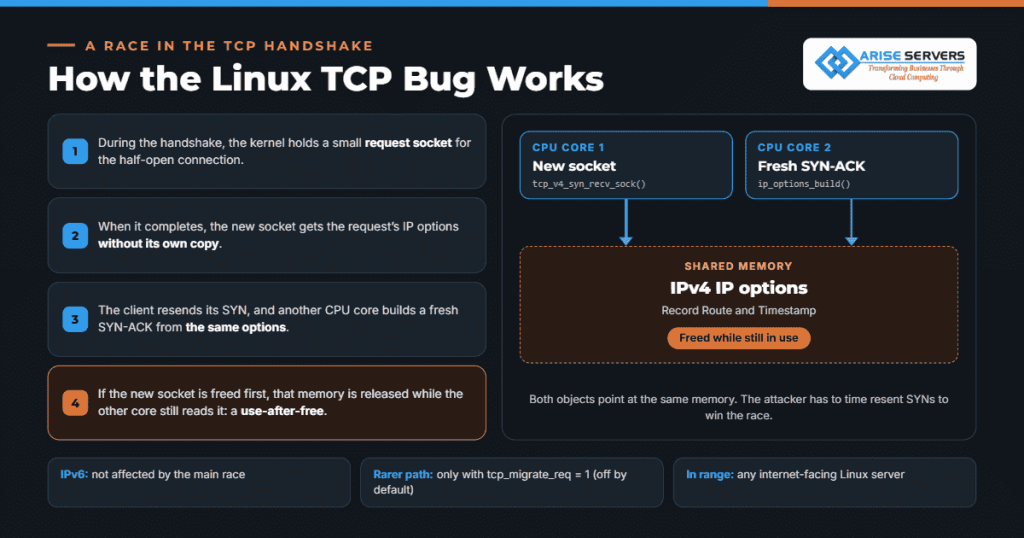
Every TCP connection starts with a handshake. The client sends a SYN, the server replies with a SYN-ACK, and the client confirms. While that’s going on, the kernel holds a small “request socket” for the half-open connection. Once the handshake finishes, it creates the real socket.
IPv4 packets can carry optional extras called IP options. Two of them, Record Route and Timestamp, matter here. They’re rarely used on the modern internet, but the kernel still supports them.
According to the kernel CVE team’s description, when the handshake completes, the function tcp_v4_syn_recv_sock() hands the request’s IP options to the new socket without making its own copy. Both objects now point at the same memory. Meanwhile, if the client resends its SYN, another CPU core may be building a fresh SYN-ACK from those same options in ip_options_build(). If the new socket gets freed first, the options memory is released while the other core is still reading it.
That’s a use-after-free: the kernel uses memory it has already handed back. Bugs like this can crash a machine. In skilled hands, they can sometimes be turned into code execution.
A few details narrow things down:
- IPv6 isn’t affected by the main race. The IPv6 version of the function copies the options properly. A separate, related IPv6 issue was noted for a later fix.
- There’s a second, rarer path. A similar race exists when half-open connections move between listening sockets. That only happens if
net.ipv4.tcp_migrate_reqis set to 1, or if a special eBPF program of typeBPF_SK_REUSEPORT_SELECT_OR_MIGRATEis loaded.tcp_migrate_reqis off by default. - It’s a race. The attacker has to time resent SYNs to hit the window. That’s why some vendors scored it lower.
VPS Server Plans
An ideal VPS solution for modern projects combines strong security, high-speed performance, and flexible, scalable configurations to match your evolving requirements.
Why the scores don’t agree
You’ll see different numbers depending on where you look:
| Source | Score |
|---|---|
| Kernel CVE team | 9.8 Critical |
| Red Hat | 9.8 Critical (raised on Nov 1, after earlier lower scores) |
| Ubuntu | 9.8, Critical priority |
| Oracle, SUSE, Amazon | 8.1 (attack complexity rated high) |
The difference is mostly about the race. Vendors scoring 8.1 think winning it is hard. Vendors scoring 9.8 don’t want to bet on that. For a public-facing server, the practical answer is the same either way: patch it in your emergency cycle, not your monthly one.
As of the most recent public tracking on Nov 12, no vendor or CERT had reported exploitation in the wild, the bug wasn’t in CISA’s KEV catalogue, and no public exploit code had been published. The fix credits Xinyang Ge of Anthropic. On Oct 27, Anthropic said its AI model had written a working root exploit for servers with an MPTCP listener. That claim hasn’t been independently verified, and the exploit hasn’t been released. The pillar post in this series, The 30-Minute Patch Window [pillar link], explains why “no known exploitation” is a weaker comfort than it used to be.
Which kernels are fixed
Upstream, the fix landed in these stable versions:
| Kernel branch | First fixed version |
|---|---|
| 5.10 | 5.10.272 |
| 5.15 | 5.15.223 |
| 6.1 | 6.1.190 |
| 6.6 | 6.6.159 |
| 6.12 | 6.12.113 |
| 6.18 | 6.18.56 |
| 7.2 | 7.2.10 |
| 7.3 | 7.3 |
Most servers run a distribution kernel, not upstream, so the distro status matters more. Here’s where the main ones stood as of Nov 12:
- RHEL 8, 9 and 10.2: fixed Nov 1. RHEL 10.3: fixed Nov 11. RHEL 7 is not affected. RHEL 9 real-time kernels had no general fix yet.
- Ubuntu 22.04, 24.04, 26.04 and 26.10 (generic kernels): fixed in -updates around Nov 5–6, with USNs following. Some HWE, older-release and cloud-flavour kernels were still pending.
- Debian 12 and 13: fixed.
- Amazon Linux 2 and 2023, Oracle Linux (UEK): fixed.
- SUSE SLES 16.0 and 15 SP4–SP6 LTSS: fixed. SLES 15 SP7 was in progress. SUSE Linux Micro 6.0 and 6.1 were listed as affected.
This changes quickly, so always confirm against your vendor’s advisory on the day you patch.
Step 1: check what you’re running
The kernel that matters is the one running now, not the newest one installed.
uname -rTo see whether the running kernel’s package mentions the fix:
# RHEL / AlmaLinux / Rocky / Oracle
rpm -q --changelog kernel-$(uname -r) | grep CVE-2026-98432

# Debian / Ubuntu (needs network access to fetch the changelog)
apt changelog linux-image-$(uname -r) 2>/dev/null | grep CVE-2026-98432
No output means the running kernel doesn’t list the fix. Your vendor may track it under a different advisory, so confirm with their security tracker before you assume the worst.
Check the second path too:
sysctl net.ipv4.tcp_migrate_req
sudo bpftool prog show | grep -i reuseport
You want tcp_migrate_req = 0 and no reuseport programs you don’t recognise.
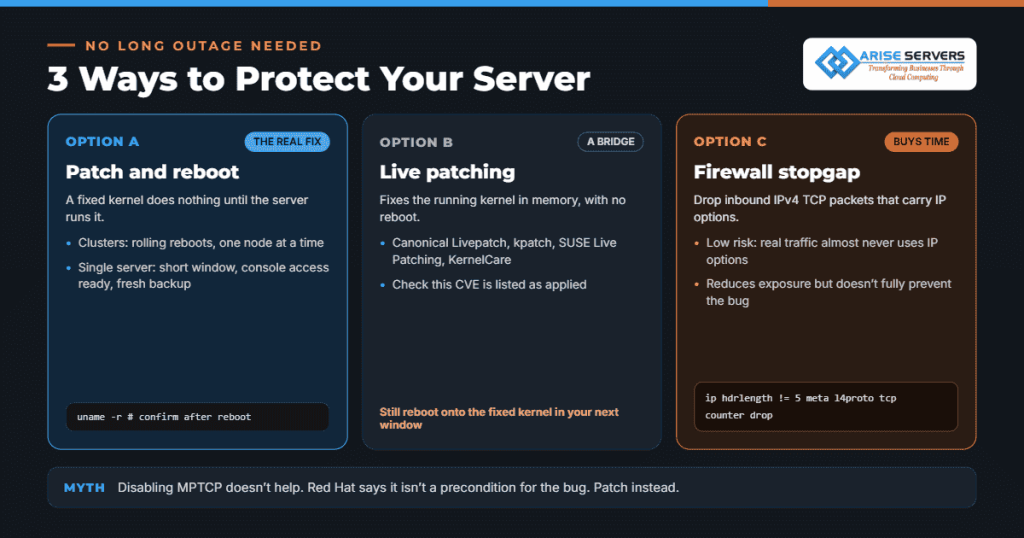
Option A: patch and reboot, without taking the service down
The only complete fix is a patched kernel that’s actually running. One advisory said it simply: a kernel fix does nothing until the system runs it. The trick is rebooting in a way users don’t notice.
If you have more than one server behind a load balancer, do rolling reboots. Take one node out of the pool, let connections drain, update, reboot, check health, put it back, and move to the next. Users see nothing. If you don’t have this kind of redundancy yet, it’s worth reading our guide on when to go multi-region. Even two nodes in one location make kernel emergencies far less painful.
If it’s a single server, plan a short window. A modern server usually reboots in a minute or two. The risk isn’t the reboot. It’s a server that doesn’t come back. Before you reboot:
- Confirm the new kernel is installed and set as the default boot entry.
- Make sure you have out-of-band console access (IPMI, iDRAC, iLO or your provider’s rescue console) in case it doesn’t boot.
- Check that services are enabled to start at boot (
systemctl is-enabled <service>). - Take a fresh backup or snapshot.
After the reboot, run uname -r again and confirm it matches the fixed version. If a server won’t come back cleanly, our guide to troubleshooting common dedicated server issues covers the usual boot problems.
Option B: live patching
Kernel live patching applies a fix to the running kernel in memory, with no reboot. Common services include Canonical Livepatch for Ubuntu, kpatch for RHEL, SUSE Live Patching, and TuxCare KernelCare across several distributions.
The catch: live patches don’t cover every CVE, and public tracking didn’t say which live patch products included this one. Check your own:
canonical-livepatch status --verbose   # Ubuntu
kpatch list                            # RHEL
kcarectl --patch-info | grep CVE-2026-98432   # KernelCare
If the CVE is listed as applied, you’re protected for now. Still plan a normal reboot onto the fixed kernel in your next window. Live patches are a bridge, not a permanent home.
Option C: the firewall stopgap
Red Hat (in RHSB-2026-016) and Ubuntu both published a mitigation: drop inbound IPv4 TCP packets that carry IP options. The race depends on SYNs with options, so filtering them removes the easiest way to trigger it.
Both vendors were clear that this reduces exposure but doesn’t fully prevent the bug. Use it while you wait for a patch or a reboot window, not instead of one.
Here’s an nftables example that does this early in the packet path. An IPv4 header with no options is exactly 5 words (20 bytes) long, so anything longer has options:
sudo nft -f - <<'EOF'
table inet cve_2026_98432 {
  chain prerouting {
    type filter hook prerouting priority -300; policy accept;
    ip hdrlength != 5 meta l4proto tcp counter drop
  }
}
EOF
If your vendor’s advisory gives an exact rule, use theirs. They’ve tested it against their kernels. To check the rule is working, sudo nft list table inet cve_2026_98432 shows the counter. On most servers it will sit at or near zero, because legitimate traffic almost never uses IP options. That’s what makes this stopgap so low-risk.
If you still use iptables, the u32 match can do the same job (-m u32 --u32 "0>>24&0x0F=6:15" matches IPv4 header lengths above 5). Test it on a non-production machine first.
One more thing to know: dropping these packets at your own server works, but filtering upstream is even better. If your provider offers network-level filtering or DDoS protection, ask whether they can drop IPv4 packets with options at the edge. Then the bad traffic never reaches your box at all.
What about MPTCP?
The Anthropic claim mentioned MPTCP (Multipath TCP), so you’ll see it come up. Some notes:
- MPTCP is opt-in on Linux, but Go 1.24 and later use MPTCP for listeners by default on Linux, so a Go service may be using it without you noticing.
- Red Hat said MPTCP is not a precondition for the bug. Turning it off doesn’t fix anything. Patch instead.
Signs something went wrong
There’s no public list of indicators of compromise. The most useful clue is a kernel crash. On internet-facing hosts, look for oops or panic messages that mention ip_options_build, ip_build_and_send_pkt or skb_under_panic:
sudo journalctl -k | grep -E 'ip_options_build|ip_build_and_send_pkt|skb_under_panic'A clean log doesn’t prove nothing happened, but an unexplained crash with those names in it deserves a closer look. If you do find one, treat it as a security incident, not just instability.
Dedicated Server Plans
Arise Dedicated Servers deliver powerful performance, reliable infrastructure, and flexible resources for businesses, high-traffic websites, applications, and demanding workloads.
A simple plan for this week
- Today: run
uname -racross your fleet and list every internet-facing server that isn’t on a fixed kernel. - Today: apply the nftables stopgap to all of them. It’s low-risk and quick.
- Today: if you use live patching, confirm the CVE is covered and applied.
- This week: install the fixed kernel and reboot, rolling through clusters node by node and booking short windows for single servers.
- After reboot: confirm
uname -r, keep the nftables rule in place a little longer if you like (it costs almost nothing), and remove it once every host is patched.
For broader server protection beyond this one CVE, see our guide on protecting VPS and cloud servers from attacks. If coordinating kernel updates and reboots across many machines is eating your week, managed Linux administration is one way to hand it off.

The takeaway
CVE-2026-98432 is a reminder that “old” code isn’t safe code. This bug sat in the TCP handshake for a decade. The good news is that it’s quite manageable: fixes are out for the major distributions, a low-risk firewall rule buys time, and with a little planning you can reboot without your users ever noticing. The servers that get hurt by bugs like this are rarely the ones that couldn’t patch. They’re the ones that installed the patch and never booted into it.
FAQ’s
Visit Our Other Server Locations
Explore our global dedicated server locations with high performance, strong security, and scalable configurations tailored for your business needs.